Get Full Government Meeting Transcripts, Videos, & Alerts Forever!
Get email alerts on the Mcpg10525 topic
No spam. Unsubscribe anytime.
Delegate Korman and WSSC discuss transparency bill; key issues include OIG peer review, ad valorem language and billing changes
Summary
Delegate Korman updated the committee on MCPG10525, describing proposed changes to WSSC governance, debates over including ad valorem tax scenarios in planning, compromises on high-bill adjustments and an OIG peer review arrangement; WSSC and the delegation agreed to draft amendments for next week.
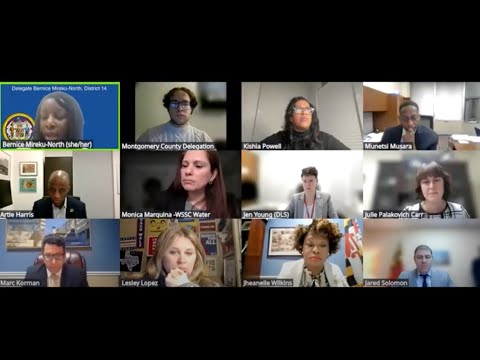
Delegate Korman briefed the Metro Washington area subcommittee on MCPG10525, the WSSC Transparency and Reform Act of 2025, outlining several negotiated changes and continuing points of discussion.
Korman said the bill would add the director of Montgomery County's Department of Environmental Protection to the WSSC commission in place of an existing member, with implementation timed to one of the next two openings and clarifying language to allow that director to serve as chair or vice chair as a voting, ex officio member (residency requirements to be exempted). County Executive Elrich supports that governance change with clarifying edits, Korman said.
Korman and WSSC staff discussed whether ad valorem (property) taxes should be modeled in WSSC long-range planning and stress testing. WSSC representatives and financial advisers warned that treating ad valorem taxes as a routine planning assumption could create a misleading presumption about the commission's reliance on that revenue; their financial adviser said ad valorem taxes are a secondary security that would cover debt service but not operations or capital. Korman said bond-rating agencies and the public may find value in transparent scenarios showing the scale of ad valorem taxes that would be required in emergency cases, and he said he was reviewing alternative language WSSC proposed.
On high-bill adjustments and customer response, Korman described a compromise in which WSSC will report on implementation of improved high-bill response practices rather than removing all guardrails, and WSSC agreed to provide suggested language changes for searchable public information and website features.
Korman proposed changing the bill's 'monthly billing' language to 'fixed billing' to allow monthly, bimonthly, quarterly or other fixed periods without prescribing a specific technology. He also described an arrangement for the Office of the Inspector General (OIG) and the Department of Legislative Services (DLS): WSSC's OIG would perform most of a DLS-proposed study and submit results to DLS, supplemented by an external peer review so the OIG does not review itself; DLS said it was initially comfortable and would double-check consistency with its practices.
Korman flagged two remaining issues: the short title of the bill (symbolic) and an Avenel-related matter affecting his district. He and WSSC said they expect to draft and circulate amendments over the next week and present them to the committee next Monday.
WSSC representatives (Monica) offered to share a recent OIG peer review and noted a 2008 document with alternative ad valorem scenarios; WSSC said its financial adviser would provide further detail on why ad valorem taxes are not included as a routine planning assumption. The committee thanked presenters and asked for written amendments for next week's meeting.
No final votes were taken on MCPG10525 at this meeting; members agreed to continue negotiations and file amendments for further consideration.