Get Full Government Meeting Transcripts, Videos, & Alerts Forever!
Get email alerts on the Sewer Conversion topic
No spam. Unsubscribe anytime.
Cathedral City pushes for state grant to convert remaining septic areas as residents press on costs
Summary
City staff and consultants outlined a plan to convert six remaining residential neighborhoods from septic to sewer, citing groundwater protection and property-value benefits; they said theyare seeking construction grant funding and asked residents to submit a nonbinding interest survey by July 22 to strengthen the application.
Cathedral City officials and their consultants presented a plan at a community meeting to pursue construction funding to convert the last six residential areas still served by septic systems to the municipal sewer network, officials said.
Project manager Elizabeth Medina told residents the city received a $2.5 million planning grant from the State Water Resources Control Board (Clean Water State Revolving Fund) and is preparing a construction grant application. "If I could give you free sewer today, would you be interested in connecting?" Medina asked the room, urging residents to use a QR code or the project website to complete a nonbinding property-interest survey by July 22.
Why it matters: The team said converting septic systems would reduce maintenance costs for homeowners, reduce odors from failing tanks and protect groundwater that local communities rely on. The project would also expand the amount of wastewater that can be treated and recycled, officials said.
Carmen, the design project manager from consultant Ardura, said preliminary engineering reports are approved and environmental documents and tribal outreach are underway. She described a funding goal of "100%" grant coverage for construction, adding that the construction grant would ideally pay for mainline pipe in the public right of way, private connections to the main, abandonment of septic tanks, inspection costs and capacity fees to the Coachella Valley Water District (CVWD). "We're shoot[ing] for a 100% funding," Carmen said, and warned that the state may fund projects on a multiyear backlog, which could push construction into the 20282030 window.
Who will build and maintain the sewer: CVWD will manage construction contracting and is expected to own and maintain new sewer infrastructure. City staff emphasized the City is the planning coordinator and not the sewer operator.
Costs and homeowner exposure: Multiple residents raised concerns that prior conversions cost roughly "$20,000 a door," and asked whether homeowners would be assessed if grant funding fell short. A resident said, "It was about 20,000 a door up there." City and CVWD staff said they cannot provide a single per-house price today because private-connection costs vary widely depending on landscaping, hardscape and the distance from house to street. Project staff said the current construction grant application is sized for existing property conditions and that private hookups could remain the homeowner's responsibility if grant funds do not cover them; they also discussed potential incentives and "track pricing" (lower contractor rates when many neighbors hook up on the same schedule) as ways to reduce per-unit costs.
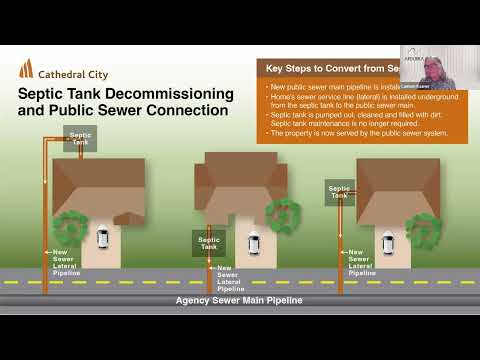
Technical and process details: Carmen explained that septic tanks will be decommissioned in place after thorough cleaning per Department of Health procedures and that private laterals will typically be replaced from just outside the septic tank to a new cleanout at the property line. Staff said lateral sizes for single-family residences generally use 4-inch pipe, with 6-inch used when required by property conditions.
Project scale and sequence: Staff estimated roughly 1,200 total connections across the six targeted areas, with about 500 properties in the three single-family neighborhoods discussed at the meeting. The team plans three construction packages (one covering a separate water agency service area, one for mobile-home parks and another for the remaining single-family neighborhoods); the largest package was described as likely requiring about a year to 18 months of work and will be staged so crews complete areas methodically.
Permitting and fees: City staff said permits for septic abandonment and private-property work will be handled by the City's building department and permits in the right of way will be coordinated with CVWD and City engineering/public works. Medina said the City is pursuing options to reduce or waive some fees during the hookup phase.
Outreach and next steps: The project team repeatedly asked residents to complete the nonbinding interest survey (online or on paper) and to help spread the word. Staff said strong community response helps advocacy for full grant funding; they reported about 150 responses collected ahead of the meeting. The city posted contact information and said it will continue outreach and return for additional conversations as design and grant applications progress.
Resident concerns left unresolved at the meeting included the precise per-property cost if grants do not fully cover private hookups, the final construction schedule (contingent on state funding timing) and whether some previously promised street connections in specific neighborhoods would be honored; staff said they would follow up on historical questions and neighborhood-specific maps.
The project team said the immediate next steps are to collect survey responses by the stated deadline, complete design documents next summer and submit a construction grant application to the State Water Resources Control Board by the end of the year; construction, if funded, could occur between 2028 and 2030.