Get Full Government Meeting Transcripts, Videos, & Alerts Forever!
Get email alerts on the School Construction topic
No spam. Unsubscribe anytime.
TAPPE outlines preliminary plan for Southborough elementary; committee flags soils, accessibility and sprinkler work
Summary
TAPPE consultants presented a preliminary work plan and an existing‑conditions review for the Town of Southborough elementary school, flagging potential needs for geotechnical testing, accessibility upgrades and an automatic sprinkler system; the committee scheduled follow‑ups and asked TAPPE to scope a geotechnical proposal.
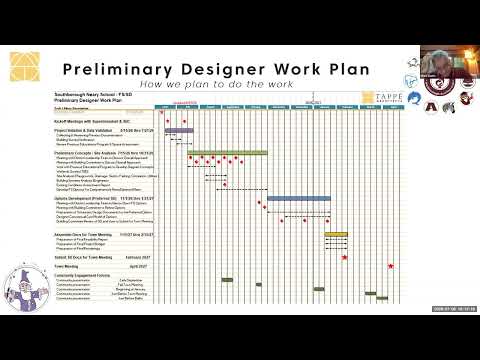
Chris, a TAPPE consultant, told the Town of Southborough Elementary School Building Committee on July 8 that his team has completed initiation and data validation steps and will move into concept development later this month, with the goal of narrowing options for a substantive town‑meeting presentation in April 2027. "We're not asking for votes tonight," Chris said, adding TAPPE will email committee members a PDF of the draft materials after the meeting.
The presentation included photographs from a June 24 site visit and a draft report summarizing TAPPE's review of prior MSBA materials and recent engineering reports. Cesar, a TAPPE architect, said the building is "well maintained" but identified several areas that will require upgrades. On the building envelope he pointed to a planned roof replacement (bid documents indicate about 14 inches of rigid insulation), cracked sealants at window frames and precast wall interfaces, and single‑pane windows that would not meet modern thermal standards. "A good envelope creates resiliency even when you have no building systems to maintain temperatures," Cesar said.
Accessibility was a central concern. Cesar reported toilet rooms, fixture clearances, door widths and hardware throughout the building do not meet current accessibility standards and that some interior configurations—such as doors set into pockets and a band‑room exit that is stair‑only—will be challenging to make fully compliant. He said some fixes may require moving plumbing carriers or seeking alternative compliance if structural constraints limit modifications.
TAPPE and committee members also discussed mechanical and electrical systems. Cesar described unit ventilators as antiquated, noted the apparent absence of a central cooling system, and said electrical panels and capacity may need upgrading if programmatic demands increase. He highlighted one statutory threshold in the discussion: the building currently has no sprinklers and "state law" language in prior reports led TAPPE to flag that automatic fire suppression could be required for an education building of the school’s aggregate size.
Soils and foundation testing were raised repeatedly. Mark, a committee member, said he had found unsuitable material near the site and that no subsurface work had been done under the existing building. He noted groundwater could be "as low as 18 inches" or roughly 2 feet below the foundation and urged the committee to understand subsurface conditions before moving structural walls. Chris said subsurface investigation is not in TAPPE's current scope and would be a reimbursable expense; he offered to obtain a geotechnical engineer's proposal estimating the cost and process for inside drilling so the committee could decide later whether to proceed.
Committee members questioned the path forward for funding and oversight. Several members noted the town must decide whether to pursue MSBA reimbursement (reentering the MSBA pipeline) or to carry out an in‑town feasibility and renovation process. "At some point the committee, the school committee and the select board will need to decide the path," one member said. TAPPE offered to advise based on prior experiences with both approaches.
Practical questions about safety and infrastructure were assigned as next steps. The committee asked TAPPE to coordinate with DPW and the fire chief to confirm hydrant flows and the potential need for a pressure pump if sprinklers are added. A nearby hydrant flow test of 4,800 gallons per minute with static pressure 98 psi and residual 76 psi was cited during the meeting and the member who shared it said he would send the source link to TAPPE.
The committee set follow‑up meetings, agreeing to convene on August 5 and again later in August while exploring a biweekly schedule for fall. TAPPE will schedule meetings with district leadership to confirm enrollment assumptions (MSBA had previously studied three scenarios), refine the educational program drivers and begin developing baseline options. TAPPE will also provide a scoped geotechnical proposal and circulate the draft report and slides shared at the July 8 meeting.
A motion to adjourn carried on a roll call (the minutes record ayes from Mark, Andrew and the chair) and the meeting ended.