Get Full Government Meeting Transcripts, Videos, & Alerts Forever!
Get email alerts on the Vic Trace Reservoir topic
No spam. Unsubscribe anytime.
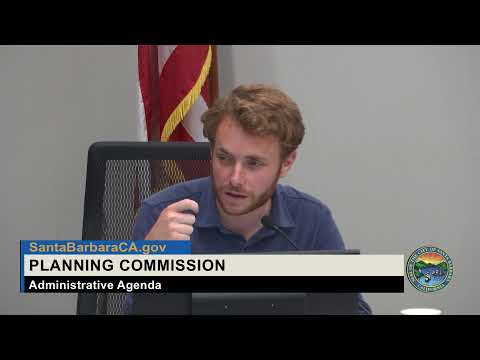
Planning commissioners review draft EIR for Vic Trace Reservoir replacement; construction noise judged significant
Summary
The Santa Barbara City Planning Commission reviewed the draft environmental impact report for the Vic Trace Reservoir replacement on July 9. Staff said construction noise is the sole impact identified as "significant and unavoidable;" no project approval was sought and public comment on the draft EIR closes July 30.
The Santa Barbara City Planning Commission on July 9 heard a staff presentation and commissioners’ questions about the draft environmental impact report (EIR) for the Vic Trace Reservoir Replacement Project, a system reliability project that would replace an aging reservoir and associated pipelines serving about 70% of the city.
Case planner Patsy Price introduced the project and Kelly Bork, acting supervising engineer in the Public Works engineering division, described the site and system context, saying the existing Vic Trace facility was built in the 1950s and stores 10,000,000 gallons of treated drinking water that supports downtown, the West Side, the Mesa and other areas. Bork said the draft EIR divides the work into on‑site improvements (new buried tanks, valve and pump station, access and security upgrades, stormwater capture) and off‑site pipeline work (replacement, relining and rehabilitation along La Cornia, Dolores and Ricardo avenues), and noted the plan includes using a nearby house as a construction office.
The draft EIR envisions two new buried prestressed concrete tanks of 5,000,000 gallons each and associated access and pump facilities; staff said the project team is aiming to break ground in 2028 with major on‑site work in 2029–2030 and construction impacts staged across roughly a three‑year period.
Amanda Antonelli of Rincon Consultants presented the EIR’s technical conclusions. She said most resource areas were found to be less than significant or less than significant with mitigation, but "noise was the one resource area where impacts would remain significant and unavoidable" for the construction period. Antonelli described the noise work: ambient measurements showed mid‑50s dBA daytime and low‑30s dBA nighttime conditions in the surrounding residential community, CEQA commonly uses a 10‑dBA increase as a significance threshold, and modeled construction noise under conservative assumptions (three loudest pieces of equipment operating) produces level estimates that can exceed both Federal Transit Administration limits and the ambient increase threshold.
The draft EIR lists mitigation measures including a construction noise control plan (NOI‑1) developed with neighborhood input, use of mufflers and engine shrouds, temporary noise barriers, strategic staging and timing, and "smart" backup alarms. Antonelli said many measures can reduce noise — for example, temporary sound barriers can reduce levels by 10–15 dBA — but because this is a quiet community with homes immediately adjacent to portions of the work, staff found no fully feasible mitigation to avoid exceeding the ambient 10‑dBA threshold for some work, making the noise conclusion "significant and unavoidable" for the construction period.
The EIR also includes mitigation for air quality (requiring Tier 4 or, if not available, Tier 3 equipment where feasible to reduce diesel particulate emissions), biological resources (worker environmental awareness training, focused pre‑construction surveys, a lemonade‑berry scrub restoration plan and tree protection for identified protected trees), cultural and tribal resources (archaeological and tribal monitoring and unanticipated discovery procedures), and paleontological measures (monitoring and targeted procedures where excavation encounters sensitive geologic units).
Commissioners asked detailed follow‑up questions. Commissioner Barnwell pressed on paleontological monitoring and whether construction monitoring would be required; Antonelli said on‑site monitors and worker training would be used and that the noise control plan could include monitoring and complaint procedures though construction period monitoring is not currently mandatory in the draft mitigation language. Vice Chair DeLucio asked about tree‑replacement ratios and whether Italian stone pine Tree 84 could be saved; staff said the Parks & Recreation Commission granted a permit describing the maximum removals but that the project team would continue to explore design and contractor approaches to preserve individual trees where feasible. Commissioner Wardlow asked about coordination with the fire department and construction hours; staff said they have collaborated with the fire department, modeled conditions for structure fires, and expect normal construction hours (approximately 7 a.m.–5 p.m.) but acknowledged certain activities — for example, large concrete pours and some welding on a 24‑inch pipeline — may require limited night work.
Staff also described outreach and process: the project team has engaged multiple boards and commissions, held two public meetings (June 24 in person and June 25 virtual), and said the public comment period on the draft EIR closes July 30; staff expects to return with a final EIR for commission consideration in January 2027 after incorporating feedback. Kelly Bork said the project team is preparing an application for the State Water Resources Control Board State Revolving Fund low‑interest loan and expects to submit by year end.
No action or project approval was taken at the hearing; commissioners generally expressed support for the investment while asking staff to clarify the parcel boundary (to confirm whether La Coronia Park should be excluded), continue discussions about saving Tree 84, provide additional details on mitigation monitoring and complaint procedures (including whether noise monitoring will be included in the control plan), and provide financing updates with the final EIR.
The public comment period for the draft EIR remains open until July 30; staff requested and received the commission’s guidance on the items above and will incorporate feedback into the final EIR.