Get Full Government Meeting Transcripts, Videos, & Alerts Forever!
Get email alerts on the Wastewater Infrastructure topic
No spam. Unsubscribe anytime.
Central Coast Water Board hears testimony on failing Hacienda Apartments septic system; officials push for owner accountability
Summary
At a Central Coast Water Board public meeting, staff said connecting the 24‑unit Hacienda Apartments to the City of Soledad sewer is the only feasible long‑term solution; residents welcomed the plan while local officials urged conditioning public funding on landlord commitments and raised jurisdictional and technical questions.
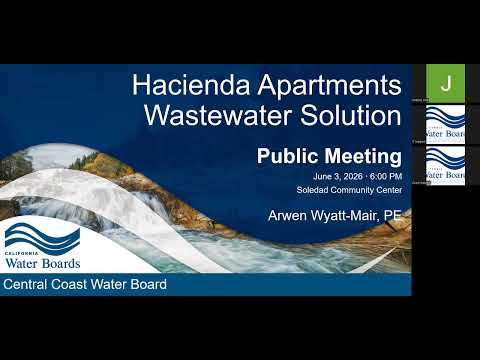
The Central Coast Water Board held a public meeting in Soledad on wastewater problems at the 24‑unit Hacienda Apartments on May 1, where staff said the complex’s septic system is failing and recommended a septic‑to‑sewer consolidation that would connect the site to the City of Soledad’s sewer system.
Arwin Wyatt Mayer, a senior engineer with the Central Coast Water Board, told attendees: “The septic system at Hacienda Apartments is failing.” Mayer and technical partners said a 2024 feasibility study by Blackwater Engineering found connecting to Soledad’s sewer is the only feasible long‑term solution, and staff described two pathways: a voluntary coordination process that would lead to a construction grant application, or, if negotiations fail, the board’s authority under Senate Bill 1215 (2018) to require consolidation.
The meeting included testimony from residents, local elected officials, county staff and technical experts. Mayor Anna Velasquez of Soledad urged a broader response that pairs infrastructure fixes with housing improvements, saying officials should not let “public investment protect private assets while residents remain trapped in unacceptable living conditions.”
Residents described repeated sewer overflows and ongoing odor and plumbing problems. One long‑term resident said the owner routinely provides temporary repairs and rent leniency but urged state and local agencies to help secure a permanent solution. Owner Nayan Patel told the board the family “do spend a lot of money in repairing the sewer almost every day or monthly,” offered to make financial records available to officials and asked for respectful treatment of the property and tenants.
Housing and equity advocates urged the board to take a holistic approach. Paul Hernandez, executive director of Water Education for Latino Leaders, supported consolidation as a tool to “advance equity, improve public health, and ensure that communities are not left behind,” while recommending that projects include protections for affordability, data privacy and tenant outcomes.
Local government speakers highlighted jurisdictional and technical complexities. Monterey County’s Craig Spencer asked for time to coordinate county investigations and potential partnerships rather than a rushed forced connection. City public works director Don Wilcox outlined three potential connection routes — the nearby Camfora (Campora) connection, an 18‑inch high‑pressure pipeline used by the California Department of Corrections and Rehabilitation, or other options — and cautioned that connecting to a high‑pressure CDCR line poses operational risks without continuous on‑site maintenance.
Board staff described available funding and incentives. A technical assistance grant is already in place and the next step is a construction grant application that must be submitted by a public agency (either the City of Soledad or Monterey County). Mayer said grant applicants could be eligible for incentives including “up to $10,000,000 in 0 percent interest rate loan” through the State Water Resources Control Board’s financing programs, and staff offered assistance developing applications and minimizing the burden on applicant agencies.
Mayer noted the Central Coast Water Board sent a 6‑month notification letter in July 2025 requiring the city and property owners to negotiate a voluntary connection; in January 2026 staff extended that negotiation period by another six months. If voluntary negotiation does not yield progress after the extended period, Mayer said the board could move to issue an order requiring the City of Soledad to provide sewer service to Hacienda Apartments.
Residents and local officials diverged on sequencing and conditions. City officials said they support the residents’ health needs but asked that any consolidation be coordinated with county land use, CEQA review and LAFCO requirements and include clarity on who will permit and construct on‑site laterals and plumbing. Several local speakers urged that any public investment be conditioned on meaningful owner participation or commitments to improve on‑site housing conditions.
The board did not take any vote at the meeting; it was convened to receive testimony and public comment as required under the negotiated‑process timeline. Staff closed by reminding attendees that written public comments are due by June 15 and that an online project page and email list are available for updates. Mayer and partners said they will continue coordinating with the City of Soledad, Monterey County, the property owners and technical assistance providers as they prepare a grant application or consider further enforcement steps.