Get Full Government Meeting Transcripts, Videos, & Alerts Forever!
Get email alerts on the Emergency Assistance topic
No spam. Unsubscribe anytime.
SPU and City Light propose expanding emergency-assistance eligibility to 80% AMI
Summary
Seattle Public Utilities and Seattle City Light presented companion ordinances to expand emergency-assistance programs to households at or below 80% of area median income, streamline enrollment and increase maximum assistance; agencies said SPU's change would expand eligible population by ~50% and City Light's by ~37%.
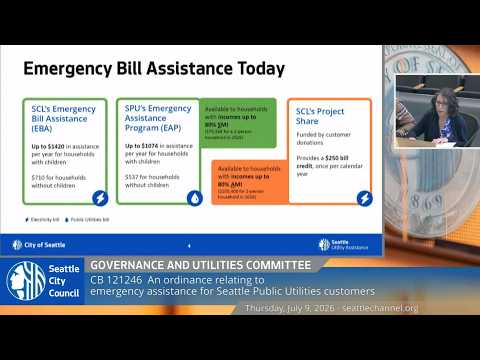
Seattle Public Utilities and Seattle City Light presented companion ordinances to expand their emergency-assistance (EAP) programs, increasing income eligibility from 80% of state median income to 80% of area median income and modernizing program rules to reduce paperwork and improve access.
City Light's interim general manager Rob Santoff said the expansion would increase City Light's eligible population by about 37% to roughly 188,000 customers and align the utility with the Washington Clean Energy Transformation Act, which requires at least one assistance program to include eligibility up to 80% AMI.
SPU staff said raising eligibility to 80% AMI would increase the program's eligible pool by about 50% (about 39,000 households), and described moving from a system where customers applied multiple times toward a streamlined single-application process that provides the full maximum assistance amount up front and applies it over time. SPU said EAP assistance equates to roughly four months of bills (about $1,000/year, or a ~30% annual discount) and can be combined with UDP benefits so deeply-burdened households receive substantial relief.
Both utilities described administrative changes to remove outdated code references (for example, replacing "single-family" language with "individually metered residences") and moving program details into director's rules to allow faster updates. City Light said it would provide the lesser of recent-billing-based benefits (two bimonthly bills or last four monthly bills) and eliminate past-due balance requirements so customers can apply before a bill becomes delinquent.
The committee did not vote on these companion ordinances at this meeting; staff said the items will be discussed again on July 29.