Get Full Government Meeting Transcripts, Videos, & Alerts Forever!
Get email alerts on the Attendance topic
No spam. Unsubscribe anytime.
Providence schools report historic drop in chronic absenteeism as local control returns
Summary
The superintendent announced a districtwide chronic absenteeism rate of 25.9% for 2025–26 — the lowest in district history and below the TAP goal — and outlined summer programming and a live 90-day dashboard as the district assumes local control.
The superintendent announced that Providence Public School District’s chronic absenteeism rate fell to 25.9% for the 2025–26 school year, the lowest recorded in district history and below the district’s 2025 TAP goal of 26.3%. “We are beating absenteeism,” the superintendent said, crediting sustained district focus, strategic investment and family engagement.
The superintendent noted the district now counts students present only if they attend at least 50% of an instructional period — a stricter standard than pre-pandemic rules — and said the result was achieved despite two major snowstorms and community upheaval following the Brown tragedy. He described summer offerings coordinated with 11 community organizations and 12 programs at 10 locations serving more than 1,000 students, supported by 237 staff and volunteers; most camps are free with costs split roughly 50% by the school department and 50% by the city.
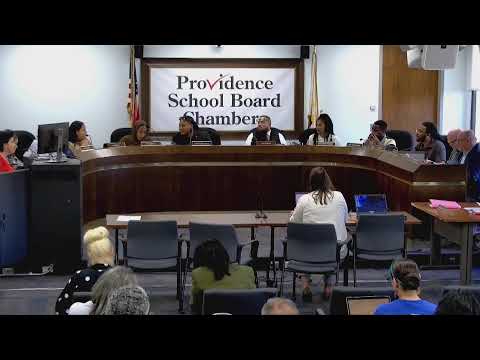
Board leaders framed the announcement as part of the broader return to local control. A board leader called the day “an important and an emotional moment” marking the end of state intervention and urged continued focus on trust, accountability and partnership as the board transitions responsibilities back to community control. Vice President Newman said stability and community-led decisionmaking were priorities during the 90‑day transition, and introduced a live dashboard to track the board’s tasks and transparency commitments.
The board’s approval earlier in the meeting of the agenda and subsequent consent items cleared the way for immediate work on the priorities shown in the dashboard. The board moved into executive session later in the meeting to address personnel and litigation matters; no executive-session actions were announced publicly at adjournment.