Get Full Government Meeting Transcripts, Videos, & Alerts Forever!
Get email alerts on the Remote Access Policy topic
No spam. Unsubscribe anytime.
Assistant City Attorney Jason Zaragoza urges Oxnard City Council to adopt remote access disruption policy before July 1 deadline
Summary
Assistant City Attorney Jason Zaragoza recommended the Oxnard City Council adopt a resolution and written policy to handle disruptions to two-way remote access, citing SB 707’s requirement that eligible legislative bodies provide two-way remote public access and adopt a policy by 07/01/2026.
Assistant City Attorney Jason Zaragoza recommended that the Oxnard City Council adopt a resolution and written policy to govern disruptions of two-way remote public access during council meetings, citing a statutory deadline.
"SB 707 requires eligible legislative bodies ... must provide 2 way remote public access ... and must adopt a policy ... by 07/01/2026," Zaragoza told the council as he outlined the draft resolution. He said the requirement applies to bodies serving populations over 30,000 and noted Zoom is the city's audiovisual platform for remote attendance.
Zaragoza summarized the policy's required elements, saying it must set out procedures for announcing a disruption, the option to adjourn or recess for at least one hour to attempt restoration, and the findings required to continue a meeting if services cannot be restored.
He described the statutory definition of a disruption as "a failure, an outage, an interruption of the city's telephonic or Internet service, that prevents members of the public from attending or observing open meetings of the city council via remote access," and added, "Just think of our Zoom platform going down." Zaragoza also defined remote access services to include two-way telephonic services or two-way audiovisual platforms used for real-time public participation.
If the council chooses to recess, Zaragoza said staff should make "good faith" efforts to restore service during that hour. He listed troubleshooting the platform or teleconferencing software, resetting or replacing audio-visual equipment, attempting alternative connection methods or platforms, contacting support staff or service providers, and switching to backup equipment or platforms as examples of such efforts.
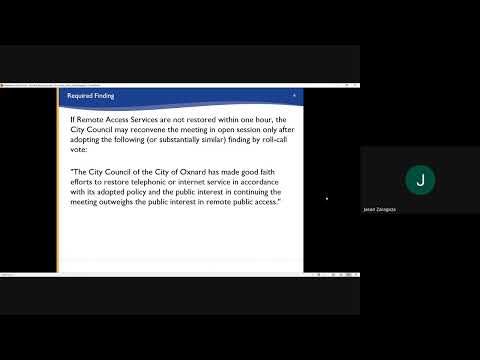
Zaragoza further said that if remote access is not restored within one hour the council may reconvene in open session only after adopting, by roll call, a finding that the city made a good-faith effort to restore services and that the public interest in continuing the meeting outweighs the public interest in remote access.
On record-keeping, Zaragoza said the clerk must note in the minutes the nature and exact time of the disruption, whether open session was adjourned or a recess used, the specific restoration efforts taken, the time the meeting was reconvened if applicable, and the finding adopted via roll call.
He recommended adopting the resolution on June 30 with immediate effect so the policy would be in place before the July 1, 2026 deadline, and clarified the policy's scope would cover only the city council as the eligible legislative body under the statute. The presentation concluded with an offer to take questions from the council; the transcript does not record any formal vote on the resolution in this excerpt.