Get Full Government Meeting Transcripts, Videos, & Alerts Forever!
Get email alerts on the School Construction topic
No spam. Unsubscribe anytime.
Medford school building committee approves space-efficiency reductions and authorizes PSR submission to MSBA
Summary
The Medford School Building Committee approved a package of space-efficiency changes for the high school project and authorized submission of the PSR to the MSBA after debate over project size and documentation; votes on the reductions and the PSR passed in separate roll-call votes.
The Medford School Building Committee voted to adopt a set of space-efficiency changes and to submit the project’s PSR to the Massachusetts School Building Authority (MSBA) after project staff presented reductions for Career & Technical Education (CTE) spaces and committee members pressed for clearer documentation and cost transparency.
Chair Jenny Graham opened the discussion by framing a phased approach to the space summary, saying the committee will consider the building section by section and work with educators on adjacencies and program needs. After presentation and discussion, the committee approved the explicit space reductions in a roll-call vote that the moderator recorded as "11 in the affirmative, 0 in the negative." Speaker 3 moved the motion; an Emily Lazaro second was recorded.
The project presenter, identified in the meeting as Dr. Glusi, outlined the main efficiency items: combining some dedicated toilet rooms and changing facilities where programs can share them; removing loft storage in select high-bay shops and relocating storage to the shop floor; reducing certain related classroom sizes while remaining within the MSBA-allowed range (about 850–950 square feet); and eliminating some separate CTE offices in favor of locked desk and storage options inside shop spaces. "They have dedicated toilet rooms in some cases. Students, we don't want them hanging out into the school because they're working on things that are getting them dirty," Dr. Glusi said while explaining why some dedicated restrooms were retained in the initial concept and why pairing adjacent programs could allow consolidation.
Not all members were satisfied the reductions went far enough. One committee member warned the proposed cuts "are great, but they're small, like, they're less than 1% by the proposed 630,000 square feet," and said a perception that the plan remains oversized could harm MSBA reception and public support. The presenter and Chair Graham responded that the programming team is auditing prior lists, that some items remain 'on the table' for later consideration, and that the MSBA had been "incredibly complimentary" of the team's work during recent coordination.
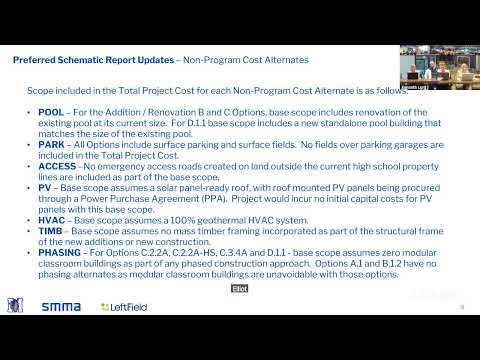
The committee then considered and authorized the PSR submission itself. The project team reported updated cost-estimator figures reflecting the reductions; the Moderator called the roll and recorded the PSR vote as "10 in the affirmative, 1 in the negative," thereby authorizing submittal to the MSBA. The team noted the PSR includes a required D1.1 NP option (a no-standalone-pool configuration) so MSBA has the alternate option to review.
Committee members pressed for clearer document control and public-facing materials: the team explained MSBA requires both a tracked-changes version and a clean version of the PSR (the same core document shown in two formats) and said the April 27 meeting video and a summer tracker will be made available on the project website. The project team also committed to more detailed programming meetings with educators in the fall to finalize layouts and teacher workspace needs.
Other procedural items included approval of the CN application (the Selection Subcommittee’s entry to the construction register) and routine minutes approval earlier in the meeting. The committee set a public schedule for upcoming meetings, with activity beginning July 1 and an anticipated selection of a firm by early October. The meeting adjourned following a final roll-call vote.
The committee’s next substantive steps are to continue educator programming meetings in the fall, publish an updated space-summary tracker on the project website, and await MSBA review of the submitted PSR.