Get Full Government Meeting Transcripts, Videos, & Alerts Forever!
Get email alerts on the Utilities Maintenance topic
No spam. Unsubscribe anytime.
Selectmen approve sewer-easement clearing and water-tank maintenance appropriations
Summary
The Waterford Board of Selectmen approved two capital appropriations to clear cross‑country sewer easements and to continue a water‑tank coating management program, after town utility staff described inspections, rental equipment needs and anticipated repairs.
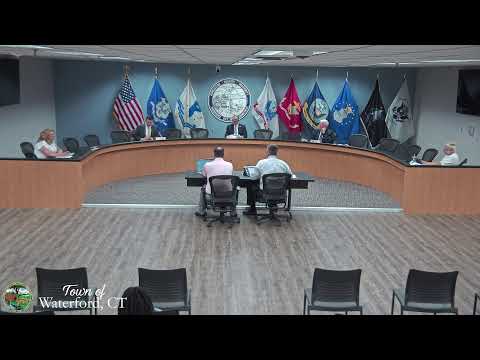
The Waterford Board of Selectmen approved two utility appropriations at a special meeting, voting to fund cross‑country sewer main access work and continued water‑tank coating maintenance.
The board voted to consider a $100,000 appropriation requested by Jill Stevens, the town's Utility Commission director, to clear overgrown cross‑country easements and allow crews to access roughly 16 miles of sewer main. Stevens told the board the work would let the town use rented brush‑hog equipment to reach easements and perform inspections; once cleared, "we can use our brush hog and other tools on our own to be able to keep them open moving forward," she said.
The appropriation is intended to provide access for inspection and early detection of infiltration and inflow (I&I). Stevens warned that the inspections will likely reveal defects: "We anticipate finding at least some I and I that will need mitigation." Board members asked about the frequency of brush‑hog maintenance; Stevens said the town typically rents the equipment about a month per year and tries to clear easements every other year depending on vegetation regrowth.
The board also approved a $45,671 appropriation to the Water Tank Management line to preserve interior and exterior tank coatings. Stevens said tank specialists (for example, CoreTech) perform nondestructive testing to measure coating thickness and assess whether recoating or replacement is needed. She described the program as an insurance policy for previously ARPA‑funded recoating work: "They maintain that asset for us. As long as we continue in the program, they make sure that the coating is in good condition."
Stevens said the town uses Department of Public Health‑approved polymer coatings for surfaces that contact water and noted that some tanks—Vauxhall and Rogers Hill—have different timelines and cost profiles for rehab. She said a Vauxhall recoating would represent a larger capital outlay and that Rogers Hill is a markedly different and more expensive tank to rehab.
Both motions carried and, as standard procedure for capital projects, will proceed to the Board of Finance for budgetary processing.
What happens next: clearing the easements will expand inspection access and likely prompt follow‑up repairs where I&I is found; the tank management appropriation is intended to avoid more costly emergency rehabilitation later.