Get Full Government Meeting Transcripts, Videos, & Alerts Forever!
Get email alerts on the Rent Stabilization topic
No spam. Unsubscribe anytime.
Salem committee backs resolution urging state to lift ban on local rent stabilization
Summary
The Salem City Council committee voted July 6 to recommend a resolution asking the Massachusetts legislature to lift the statewide ban on rent-stabilization policies, approving two amendments that replace a fixed 5% cap with a CPI-based formula and broaden the resolution to support lifting the ban statewide. The measure now goes to the full council.
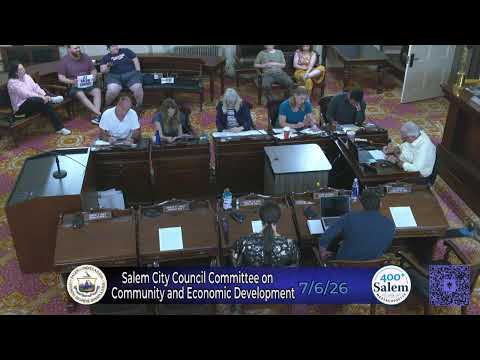
A Salem City Council Committee on Community and Economic Development meeting on July 6 recommended a resolution urging the Massachusetts legislature to lift the statewide ban on rent-stabilization authority and give cities and towns local option to pursue rent-stabilization measures.
Ward 5 Councilor Lydia King, who introduced the resolution, said the goal is local control. "This is about us having the power to make decisions for ourselves," King said, framing the proposal around rising local rents and instability for long-term residents. King moved two amendments during the committee meeting that altered the resolution’s text and were approved by the committee.
Caroline (Carolyn) Chu, executive director of Homes for All Massachusetts, told the committee the organization is pursuing both a legislative path and the momentum that grew from a ballot campaign. Chu described the legislative language referenced in the presentation (identified in discussion as S1447 / H2328) as a local-option approach that would limit annual rent increases by indexing to inflation, exempt small owner-occupied buildings, exempt certain subsidized or nonprofit housing, and place a temporary exemption for new construction. "Our bill ... would allow cities and towns to opt into a policy that limits annual rent increases to the cost of living," Chu said, and added the compromise drafts also include protections against no-fault evictions and a process for above-cap capital improvement pass-throughs.
Committee debate focused on trade-offs. Some members worried restrictive caps could dampen housing production or create incentives for condo conversions and reduced maintenance. Councilor Flynn said he had studied past rent-control problems and asked whether landlords might neglect properties or convert units; Chu replied that the compromise measure differs from older rent-control schemes and that modern CPI-linked caps are meant to be predictable for both tenants and landlords. Several councilors urged pairing any local option with zoning and other production-focused reforms.
Public comment was strongly represented. Former Ward 3 Councilor Jeff Cohen described his experience as an owner-occupant landlord and cited local market data to argue many long-term tenants have been priced out. Multiple residents, renters and housing advocates urged the council to preserve the choice for Salem voters and to send a clear signal to Beacon Hill that the city wants authority to consider rent-stabilization measures.
On process, Councilor King proposed and won two amendments: the committee struck language specifying "a cap of 5%" and replaced it with wording calling for "limiting annual rent increases based on a formula accounting for the consumer price index;" it also replaced a clause naming a specific act with language expressing support "for lifting the ban on rent stabilization statewide." King moved that the committee recommend the amended resolution to the full City Council for passage; the chair announced the motion passed and the committee adjourned.
The committee did not record a detailed roll-call vote in the spoken record included in the meeting transcript; the chair announced that the matter passes and the resolution will be entered onto the full council agenda for Thursday, when the council will have another opportunity to debate and vote on the measure.
What happens next: the amended resolution will be presented to the full Salem City Council on Thursday; any further amendments or a final council vote will be recorded at that time. The committee’s recommendation does not itself change local law — it signals to state lawmakers and begins the local deliberative process about whether and how Salem might exercise a future local option for rent stabilization.