Get Full Government Meeting Transcripts, Videos, & Alerts Forever!
Get email alerts on the Rezoning topic
No spam. Unsubscribe anytime.
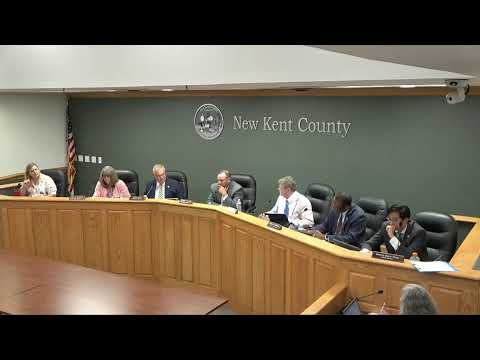
Board approves rezoning of 342.85 acres to Economic Opportunity over residents’ objections
Summary
The Board of Supervisors voted 3–2 to rezone about 342.85 acres along Routes 33/249 to Economic Opportunity for mixed commercial and light industrial development; opponents cited wetland encroachments, Chesapeake Bay TMDL constraints and two documented archaeological sites and urged deferral until further testing and tribal consultation.
The New Kent County Board of Supervisors on July 13 adopted Ordinance O‑10‑26 (ZM‑02‑26), rezoning roughly 342.85 acres owned by the Curtis Group to the Economic Opportunity district, following a staff recommendation and a closely divided board vote.
Patrick Silva, principal planner for the county, presented the application and described voluntary proffers submitted by the applicant to mitigate impacts: a 100‑foot vegetative buffer (wider than the county standard), construction hour limits (7 a.m.–7 p.m., Monday–Saturday), limits on building heights (proffered 60‑foot maximum rather than the 75‑foot allowance), proffered transportation improvements (driveway geometry, green‑T intersection or VDOT alternative), and an archaeological‑study proffer requiring a Phase 1 study within 200 feet of two Department of Historic Resources sites (44NK0219 and 44NK0220).
Applicant attorney Jared Anderson said the proffers would "run with the land" and be enforceable if accepted by the county; he reiterated that the rezoning itself does not authorize any specific tenant or a data center and that development would still be subject to site plan review, environmental permits and VDOT approval.
Residents and preservation advocates urged the board to defer rezoning until further testing and tribal consultations are completed and until more detailed water‑quality and stormwater analyses are available. Meredith Rose and others noted that large portions of the property lie within resource protection or management areas; Rose asked whether rezoning should proceed "before the applicant demonstrates consistency with every applicable provision of the comprehensive plan." Jason Knapp and other speakers pressed the board to require archaeological Phase 2 testing and consultation with the Chickahominy, Pamunkey, Mattaponi and Rappahannock tribes before a vote.
Supporters said the proposal aligns with the county’s comprehensive plan's Economic Opportunity designation and could diversify the tax base and bring retail and light industrial tenant spaces the county lacks. Andy Shine said the development would "add much‑needed economic development without adding more to Exit 211."
On the motion to adopt the ordinance, the board recorded three votes in favor and two opposed; the motion carried. The applicant proffered that any site plan within 200 feet of the two recorded archaeological resources shall trigger a Phase 1 archaeological study under Section 106 of the National Historic Preservation Act, and that any culturally significant areas found would not be disturbed.
What this means: the rezoning changes the allowed zoning classification for the three parcels; future site‑specific proposals for development will be reviewed under site‑plan, environmental and permitting processes, and will be required to comply with the proffers the applicant volunteered and applicable state and federal permits.