Get Full Government Meeting Transcripts, Videos, & Alerts Forever!
Get email alerts on the Lead Service Line Replacement topic
No spam. Unsubscribe anytime.
Wausau officials press funding for lead service line replacements; ordinance debate centers on homeowner mandates
Summary
City staff reported more than 2,600 private lead service lines replaced to date, strong grant awards and a high homeowner consent rate, and said an ordinance would boost DNR scoring — but alderpersons warned against mandating work inside private homes; no ordinance vote was taken.
Wausau city staff and a contractor outlined the scale and funding of the city’s lead service line replacement effort and previewed a possible mandatory ordinance that council members said would help win grant points but could compel homeowners into a contested private obligation.
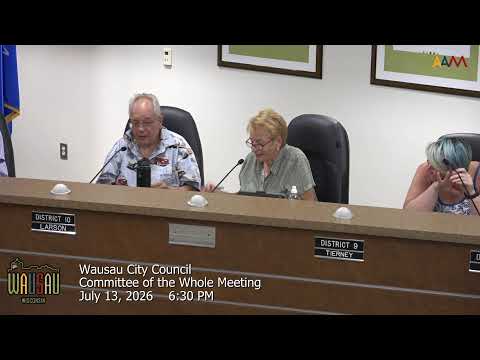
Sean Egged of Community Infrastructure Partners, the contractor managing replacements for the city, told the Committee of the Whole that the program began in mid‑2024 and has replaced “more than 2,600” private lead service lines so far, with the city on track for “over 3,500 by the end of the year.” He said the program has achieved about a 96% homeowner consent rate and completed “more than 8,000 verifications” to identify unknown service lines. Egged also said Wausau has received substantial principal‑forgiveness grant support: “to date we’ve received over $20,000,000 in principal forgiveness grants,” and the city also received outreach grant funding to boost canvassing.
The presentation stressed both operational gains and technical limits. Egged said some properties—called “rock homes”—require open‑trench work that is slower and costlier (about two replacements per day for rock sites versus seven to 12 on standard jobs) and that early contracting in 2024 locked favorable unit pricing (reported around $6,000–$7,000 per full replacement then, versus $10,000–$12,000 in some larger, later‑mover cities).
Why it matters: staff said a local ordinance would improve Wausau’s ranking for Department of Natural Resources (DNR) grant scoring and thereby increase access to principal forgiveness and subsidized financing. Egged warned that the DNR and federal timelines add urgency: staff asked for funding plans now because, he said, 2027 is the last year to use DNR public‑side subsidized SRF terms and that the EPA’s lead and copper rule improvements call for complete system replacement by 2037 (at least 10% per year).
Alder concerns and enforcement limits: several alderpersons, including Alder Cheney, said they were uneasy with language that could compel homeowners to allow replacements. “I have a real hard time mandating to somebody what they need to do in their own home,” Alder Cheney said during questioning, offering a private‑property and radon analogy to voice resistance to a strict mandate. City staff responded that the ordinance would primarily improve funding eligibility and that, practically, the utility cannot replace a private side line without homeowner permission: Lindman said if a homeowner refuses, “the city can’t replace their portion of the lead service line,” even though the city owns the public side to the curb stop.
Staff also acknowledged unclear or evolving language. Director Eric Lindman said the ordinance draft before council contained language the council had previously asked to include but that he expected to recommend reverting to an earlier draft when the ordinance returns, allowing the council more flexibility to set funding or financing options for private‑side work.
Numbers and next steps: presenters said the city applied this year for roughly $18.6–$19.0 million to replace about 1,300 service lines; the transcript cites both figures and staff characterized the final award as uncertain. Egged identified $328,000 in outreach grant funding and reported prior principal‑forgiveness awards totaling in the millions. No ordinance vote occurred; Lindman said the item will go to the utility commission for further discussion and then return to council in the coming months for committee and possible council action.
The committee did not take formal action tonight on the ordinance. The next procedural steps are a utility commission discussion and follow‑up committee hearings before any ordinance would be adopted.