Get Full Government Meeting Transcripts, Videos, & Alerts Forever!
Get email alerts on the Bonds And Finance topic
No spam. Unsubscribe anytime.
Concord School Board approves loan resolution to enable borrowing for middle-school project
Summary
After public comment and debate about tax impacts, the Concord School District board voted to approve a loan resolution authorizing the district to go to market for bonds to finance the new middle-school project, moving the financing process forward.
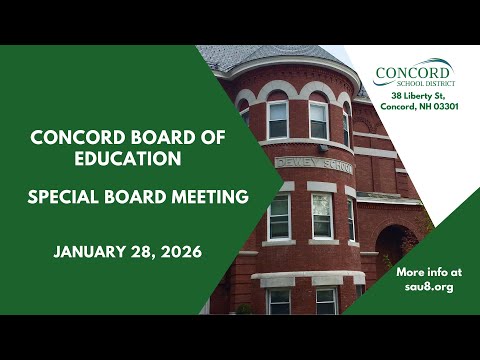
The Concord School District Board of Education voted on Jan. 28 to approve a loan resolution authorizing the district to proceed to the bond market for financing of its middle-school project.
The resolution, which the board’s finance committee recommended after a public hearing, authorizes the district to seek bond financing for the project and to compile the documentation bond counsel requires before borrowing occurs. Staff said they had submitted a preliminary official statement, the district audit and documents requested by S&P ahead of a rating call; the district’s reported rating on the call was referenced as “AA minus.”
Board members discussed the project’s cost and the timing of borrowing. Staff presented modeled scenarios for an initial authorization of $80 million as an example and two amortization options (20- and 30-year) to show tax-rate impacts. Staff said the modeling assumed no valuation growth and conservative interest-rate assumptions (examples used: 3.5% for a 20-year schedule, 4% for a 30-year schedule) and explained how the district’s stabilization fund could be used to smooth near-term tax impacts.
Public commenters expressed divided views at the public hearing. Roy Schweiker urged the board to consider an equal-payment structure and a longer (30-year) schedule to reduce early-year tax burdens. A resident identified as Stacy Brown criticized the meeting notice for a large authorization and argued that packet materials did not clearly list existing bonded debt, warning of disproportionate impacts on mobile-home residents and lower-income taxpayers. James Richards, another resident, urged the board to move ahead to avoid higher construction costs later due to inflation.
Trustees acknowledged those concerns but also emphasized rising construction costs and the risk of further price escalation from delay. Several trustees said renovation alternatives had been considered and that building a new facility now could be more cost-effective in the long run given market trends.
The motion to approve the loan resolution was moved and seconded; the board approved the resolution in a roll-call vote with all present voting yes (roll call recorded affirmative votes from Miss Campbell; Mister Du Bois; Miss Hastings; Miss Higgins; Miss Meeker; Miss Munoz; Estowski; Miss Walsh; and the chair). The vote authorizes bond counsel and staff to proceed with the next steps in borrowing; it does not itself authorize the district to borrow a specific principal amount on a particular date. Staff said specific bond issues — including final par amounts, terms and interest rates — will come back to the board for approval when the district places the bonds.
The board followed with a motion to enter nonpublic session under RSA provisions related to security and safety.