Get Full Government Meeting Transcripts, Videos, & Alerts Forever!
Get email alerts on the Cultural Arts Center topic
No spam. Unsubscribe anytime.
Villa Rica council directs staff to study converting downtown church into cultural arts center
Summary
Councilman Barr presented a resolution directing staff to research converting the church at 206 North Avenue into a Villa Rica Cultural Arts Center; staff outlined funding options and a potential phased opening by late 2026 while some council members urged clearer language and more vetting of costs and management models.
Councilman Barr introduced a resolution on July 7 asking the mayor and council to direct city leadership to study converting the church at 206 North Avenue into a Villa Rica Cultural Arts Center, including feasibility work, architectural designs, budgets and funding options.
The resolution, Barr said, is intended to start a formal planning process: “This resolution … is basically to direct or instruct the leadership to go back, do further research, planning, architecture designs, budgeting,” and return with concrete numbers and options for council approval, he said.
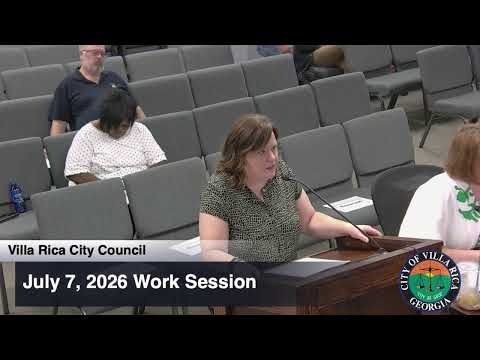
Brreka Carter, director of community economic development for the City of Villa Rica, told the council staff reviewed assets and downtown opportunities and recommended reusing the building for indoor performances and community events to complement the existing outdoor amphitheater at the mill. Carter said the city has local partners (including the library) and relationships with nearby arts centers to lean on for guidance and programming connections.
Council members discussed funding approaches and governance. Carter noted existing resources the city could explore, including economic development set‑aside funds and hotel/motel product development funds; staff reported roughly $238,000 currently earmarked in economic development funds tied to a former Butterball property. Councilman Barr and Carter said the city manager would be authorized to pursue grants, donations, sponsorships, and public‑private partnerships if the council supports moving ahead with the study.
Some council members urged caution on committing taxpayer dollars without more vetting. Mayor (name not stated) said he wanted feasibility results before authorizing development: “I would like to see us actually get the information, research, feasibility, and everything else maybe before we authorize that,” he said. Councilman Montahan suggested changing cover‑sheet language to say the city would “explore” development rather than immediately authorize it; Barr agreed to amend the language for the Tuesday council meeting.
Council members also discussed management models, with one member saying a nonprofit operator could reduce reliance on city funds. Barr and others described potential revenue opportunities from rentals for events and festivals but acknowledged costs were not yet fully estimated.
Next steps: staff will finalize the resolution language to reflect an exploration and feasibility study, and will return to the full council on Tuesday with the amended cover sheet and, later, research and cost options for formal consideration.