Get email alerts on the Juvenile Justice topic
No spam. Unsubscribe anytime.
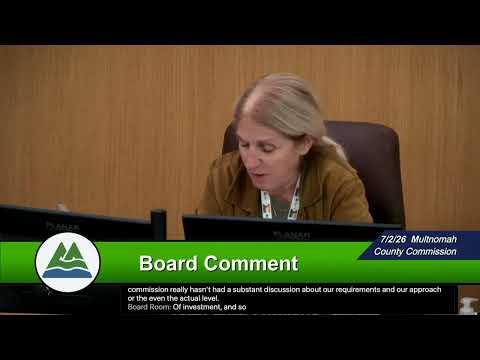
Multnomah County adopts juvenile population emergency release plan after debate over victim notifications
Summary
The Multnomah County Board adopted a resolution creating a tiered emergency release plan for juvenile detention that clarifies operational triggers, daily census reporting and victim‑notification procedures. Commissioners amended the resolution to include an addendum and debated requiring DA notification ahead of releases.
The Multnomah County Board on July 2 adopted a resolution authorizing a population emergency release plan for the Department of Community Justice’s juvenile services division to manage capacity overages at the county juvenile detention facility.
The plan establishes three tiers of review for potential releases and clarifies when DCJ staff can transition lower‑risk youth out of secure beds, how the county will provide a daily census to commissioners, and how victim notifications will be handled. ‘‘The plan defines maximum operational capacity as the lower of physical bed space, budgeted capacity or the number of youth manageable under staffing ratios,’’ said Dr. Kyla Armstrong Romero, the juvenile services division director.
Why it matters: Commissioners said the plan gives the board clearer operational detail and accountability if the county must use capacity‑management releases. The plan routes most release decisions through DCJ for lower‑risk youth while preserving a statutory firewall for youth accused of violent offenses that requires judicial review.
What the plan does: Dr. Armstrong Romero described the tiered framework: Tier 1 covers technical violations and short‑term sanctions; Tier 2 applies to certain pre‑adjudication cases that may face external placement barriers and are governed by screening instruments and risk criteria; Tier 3 contains charges that cannot be released except by a judge. ‘‘Tier 3 establishes a strict statutory firewall,’’ Armstrong Romero said. The resolution also directs DCJ to supply commissioners and criminal‑justice partners with an automated daily census pulled from the juvenile case management system.
Victim notifications and consultation: DCJ staff explained that victim notification is carried out through a shared platform with the district attorney’s office and that victims who opt in receive outreach at key stages, including releases. DCJ deputy director Suzanne Brown McBride said the department handles notifications and referrals, but warned resources are strained: the division eliminated a victim‑advocate position last year. The DA’s office supported consultation, with its deputy saying advance notice helps with safety planning, but noted 24‑hour lead time would not always be possible.
Amendments and votes: Commissioners debated a sponsor’s amendment to make the board’s posted addendum an adopted document; the board voted to include the addendum. A later amendment that would have required the juvenile services director to notify the district attorney’s juvenile unit no less than 24 hours before any forced release was discussed at length, narrowed to apply only to Tier 3, and ultimately failed in a roll‑call vote. The underlying resolution, as amended to include the addendum, passed by roll call.
What’s next: DCJ agreed to begin providing the daily census to the board immediately. Commissioners said they will watch use of the emergency mechanism closely and expect regular reporting on any operational activations of the plan.
Attribution: Portions of this article are based on presentation and remarks by Dr. Kyla Armstrong Romero (Juvenile Services Division director) and Suzanne Brown McBride (Deputy Director, Department of Community Justice), and on testimony and comments from the district attorney’s office and multiple commissioners during the July 2 board meeting.
AI generated
The text on this page is AI generated. Summaries, highlights, analysis, and video transcripts are all produced from the original source material.
AI can make mistakes, so if you spot one, and we will fix it for everyone.
Note: the source content is unaltered by us. Any content source we link to, be it a video, an audio recording, or a document, is presented exactly as its publisher released it. That publisher is usually a government body, sometimes an individual official or another organisation.