Get Full Government Meeting Transcripts, Videos, & Alerts Forever!
Get email alerts on the Wild Horses topic
No spam. Unsubscribe anytime.
Wyoming panel presses BLM, Congress after officials report wild-horse herds far exceed targets
Summary
A legislative interim committee was told Wyoming has about 7,165 wild horses while its combined appropriate management level (AML) is 2,566; BLM cited funding and holding-capacity limits for gathers and urged congressional funding while the committee asked staff to convene field reps and the state's congressional delegation to plan actions.
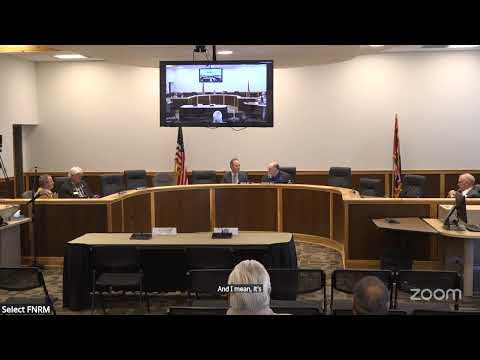
A Wyoming legislative interim committee on July 13 heard BLM officials and state staff describe an overabundance of wild horses on public lands and agreed to seek coordinated federal‑state action.
Chris Kirby, acting state director for BLM Wyoming, told the Select Federal Natural Resource Management Committee that BLM's March 1, 2026 inventory estimated 7,165 wild horses in Wyoming compared with a combined state AML of 2,566. "We are over AML," Kirby said, and emphasized that "the problem is large." He said the agency placed 8,080 animals into private care in 2025 and that national inventory estimates put roughly 85,466 animals on BLM‑administered land.
Why it matters: Committee members said drought and limited water and forage have intensified the problem for permittees and wildlife. Several lawmakers described localized impacts on deer and sage‑grouse habitat and pressed BLM for faster action and funding.
Limits on current tools: Kirby and Brad Purdy, senior advisor for BLM Wyoming, said the agency can use gathers, fertility control and adoption but faces three main constraints: annual congressional funding for gathers is limited and allocated nationally; holding capacity for removed animals is constrained; and litigation can block planned gathers. "The horse gathers are pretty expensive," Kirby said, and noted that gather funding is divided among states, meaning BLM must prioritize where to operate each year.
On fertility control, Kirby said the methods are effective in some herds but lose potency over time and are operationally difficult in herds that are not accustomed to human presence. "Fertility control can be effective, but it very much depends on the nature of the herd," Purdy said, describing examples where darting or trap‑based treatments were feasible.
Costs and capacity: In response to member questions, BLM provided a broad cost range for animals held off range and in the system. A BLM speaker summarized: "15,000 to 45,000 per animal once they go into the off‑range crowds," and a BLM official later placed the national program budget at roughly $150 million a year, with about $100 million for holding costs.
State options and statute: Ben Bump, assistant director at the Office of State Lands and Investments, described a Wyoming statute (11‑31‑2015 subsection c) that allows the state to invoice the federal government for grazing costs on affected nonfederal lands "as determined by the governor." Bump explained the invoice calculation (horse AUM conversion factor, state lease rates, and a triple rate for horses above high AML).
Tribal experience and partnerships: Tribal representatives described a large removal effort on the Wind River Reservation that reduced feral horses from about 9,000 to roughly 1,500 and said wildlife and vegetation responded quickly. Tribal leaders and the governor's office noted the effort relied on a mix of tribal, state and federal funding and logistical support.
Honor Farm adoption program: The Wyoming Department of Corrections and Honor Farm officials highlighted a long‑standing training and adoption partnership that they said achieves very high adoption rates and provides inmate vocational training. BLM and committee members acknowledged the Honor Farm as a high‑value placement pathway and scheduled a committee visit to the facility.
Federal policy constraints: Committee members and the governor's policy director, Randall Luthy, discussed a longstanding budget rider that, as passed in recent appropriations, has restricted use of appropriated funds for euthanizing healthy, unadopted animals — a limit several members said hinders options. Luthy urged engagement with the congressional delegation to secure additional funding or reconsider statutory riders.
Committee action: Members asked LSO staff to draft an informal letter requesting a meeting with field representatives from the state's congressional delegation and relevant federal officials to map options, clarify statutory pathways (including possible use of Good Neighbor Authority or state invoices) and identify funding needs. The committee did not take any binding legislative vote that day.
What's next: BLM said it is monitoring herds through the summer and plans some gathers (including a 1,000‑horse gather in the Red Desert Complex) where funding and court status allow; committee members expect follow‑up briefings and a coordinated meeting with delegation field reps to consider legislative and funding steps.