Get Full Government Meeting Transcripts, Videos, & Alerts Forever!
Get email alerts on the Teacher Pay topic
No spam. Unsubscribe anytime.
Hernando officials say state guidance narrows growth-pay funds to a small subset of teachers
Summary
District staff and union representatives said Florida Department of Education guidance limits growth-allocation pay increases to classroom teachers with 10+ years of Florida experience, leaving hundreds of experienced instructional staff outside eligibility; the district will submit an MOU by Oct. 1 and expects the first adjusted pay to appear on the Aug. 10 paycheck (millage 2).
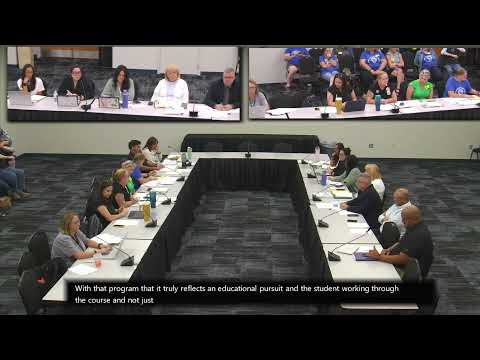
District staff and union representatives in Hernando County reviewed new Department of Education guidance that narrows how the state’s teacher-salary growth allocation may be used, and warned the limits leave most instructional staff outside the eligible pool.
"They only want us to spend it on people with 10 years more experience in their classroom teachers," said Matt Goldrick, the district’s director of labor relations and professional standards, after circulating the DOE FAQ and the October 1 reporting form. The district plans to rely on a mutually agreed MOU to meet the DOE reporting requirement by Oct. 1.
Why it matters: The DOE language, as read to the group, targets the largest portion of the funding toward classroom teachers with at least 10 years of Florida classroom experience. Staff noted that many instructional employees — including instructional coaches, counselors, social workers, school psychologists and related-services therapists — would be excluded under the statute’s classroom definition.
Union representatives and staff said the exclusion would leave most of the bargaining unit out of the growth allocation. Participants confirmed 664 classroom teachers meet the 10-plus-year classroom threshold, while the bargaining unit is roughly 1,535–1,575 members, meaning hundreds of experienced instructional staff could see no portion of the new funds.
District staff also reviewed recent growth-allocation totals for Hernando County. A presenter summarized the "new funds" in recent years as about $1,900,000 (2022–23), $2,035,000 (2023–24), $1,586,000 (2024–25) and a prior-year reduction to $809,000; this year’s figure was discussed as approximately $1.645 million but with added eligibility constraints. "Last year is the outlier," a union representative said of the small 809,000 figure.
Alexis Brown, director of human resources, told the group that the district’s long-term expenditures to maintain prior raises already exceed the state maintenance allocation and estimated the district-level shortfall at about $13,000,000 when measured against the maintenance calculation the form requires.
Timing and money: Participants clarified that the DOE will distribute the maintenance allocation with the first FEFP payment, but the growth allocation may be withheld until the district submits a board-approved and union-ratified plan and the DOE deems it compliant. Goldrick said the district will submit an MOU by Oct. 1 and that, operationally, the district expects a millage-recalculation payment to appear on the Aug. 10 paycheck.
Back pay and verification: The FAQ notes that employees who separate before increases take effect may be entitled to a prorated portion of back pay. HR staff advised employees to begin the verification process for out-of-state or prior-district years of experience now so that any retroactive adjustments can be documented and paid if required.
What’s next: Staff said they will circulate the year-by-year allocation/expenditure handout requested in the meeting, and the group agreed to reconvene Wednesday at 10 a.m. to continue negotiations and finalize language for the MOU.
No formal votes were recorded at the session.