Get Full Government Meeting Transcripts, Videos, & Alerts Forever!
Get email alerts on the Utilities Budget topic
No spam. Unsubscribe anytime.
Ashland officials flag utility budget changes, substation repairs and rate study
Summary
The Ashland Select Board reviewed detailed 2026 budgets for water, sewer and electric, heard that a $30,000 grant will fund preliminary work on an alternative tank site (with a $15,000 local match), and discussed substation repairs and bond financing that could affect utility rates pending a rate study.
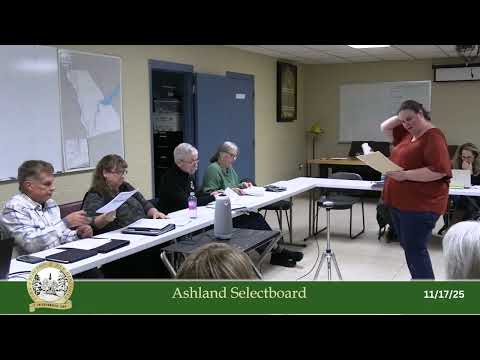
The Ashland Select Board spent the bulk of its meeting reviewing proposed 2026 budgets for the town's water, sewer and electric utilities and discussing a planned substation rebuild that officials said could affect future rates.
At the meeting, the utility presentation covered salary and operating line items, planned capital work and grant awards. The presentation noted a $30,000 sustainability grant to study an alternative tank site; that award requires a 50% town match, meaning the town will need to add $15,000 to the water grant line for a total project estimate of about $45,000. "So I found out today that we were actually worth $30,000 in grant funding," the Director said, explaining the change and the need to adjust the match figure.
Officials walked the board through numerous line items: meter replacement and AMI hosting costs, training and overtime for operators, SCADA and computer-contract fees, generator and lab maintenance at the water plant, PFAS testing costs at the sewer lagoons and monitoring-well sampling. On PFAS testing, the Director told the board that individual tests ran roughly $400, a cost that can grow quickly when every lagoon cell must be sampled.
The electric budget discussion emphasized two urgent items: higher measured demand after a recent meter multiplier adjustment and a planned substation rebuild. The presenter said the meter change had raised the measured demand bands on some meters and that the board will revisit electric figures after a consultant's rate study. "We are hoping to hear back from [the rate study consultants] in the near future," the Agency official said, noting the study will provide formulas and scenarios to guide rate adjustments.
Board members pressed presenters on long-term financing. Officials said two existing bonds will end in the next two years but that several larger-authorized projects remain; the town intends to use an asset-management tool (a grant-funded program) to sequence projects and better estimate future borrowing needs. One presenter summarized the cash position and constraints plainly: with current user fees and septage revenue, the utility leaves just over $100,000 of cushion if all budgeted spending occurs, making a $5 million cash purchase infeasible without borrowing.
Presenters also described power-purchase arrangements and wheeling charges associated with the town's contract through 2029, and how excess power is handled by the brokerage. Staff reported year-to-date collections of about $3,034,550 and said recent collection efforts have cut arrearages significantly; they also noted an insurance payout of roughly $262,000 tied to a substation explosion.
What happens next: the board agreed to revise budget figures after the rate study and before a formal vote. Officials said the rate study should arrive in the coming weeks and will inform whether and how customer rates must change to cover increased costs and debt-service for planned projects.