Get Full Government Meeting Transcripts, Videos, & Alerts Forever!
Get email alerts on the Budget topic
No spam. Unsubscribe anytime.
East Troy board sees multi‑year deficits, leans to spring referendum after finance committee forecast
Summary
Administrators told the board the district faces a multi‑year shortfall — roughly $2 million in 2027–28 and nearly $3 million in 2028–29 under current projections — and trustees said they prefer a spring referendum to allow more community outreach before asking voters for funding.
Administrators and the finance subcommittee told the East Troy Community School District board that the district faces a multi‑year operating shortfall and outlined options for a possible operational referendum.
The finance subcommittee presented forecast scenarios showing a roughly $2,000,000 deficit in 2027–28 and almost $3,000,000 in 2028–29 if the district does not pursue new revenue, which could require steep cuts including staffing reductions. The subcommittee also presented alternatives for two‑, four‑ and five‑year referendum asks and a “bare minimum” ask to hold the status quo.
“Again, if we don't pursue a referendum or if another referendum fails, then we've got a deficit of about $2,000,000 in the next year and about $3,000,000 in the one after that,” the finance subcommittee presenter reported during the meeting.
Business office projections presented earlier showed a near‑term deficit in the district software model of about $1,388,206 with continuing uncertainty until pupil counts and valuation figures are final in October. The business manager also provided early tax‑levy figures, noting last year’s levy of $20,374,669 and an early projection of $18,369,178 for 2026–27, and mill‑rate estimates near 6.33 to 6.13.
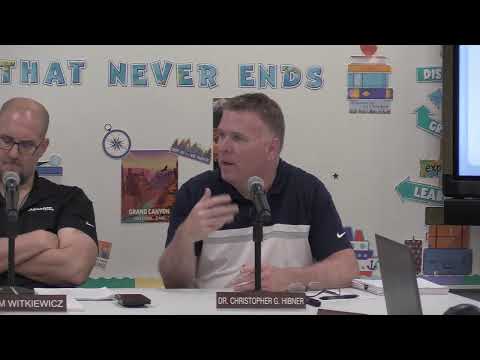
Board members debated timing and strategy for a community vote. Several trustees urged more time for public outreach and analysis before placing a question on the ballot. “So I think spring is what we target, at least for now,” the chair said, reflecting a preference among several trustees to allow more time for community engagement and to refine the dollar amount being requested.
Administrators and the committee recommended that, should the board decide to pursue a referendum, it first clarify the district’s priorities and conduct targeted community outreach to explain tradeoffs between shorter‑term asks (which require more frequent votes) and longer multi‑year asks (which require a larger amount upfront to account for inflation).
What’s next: trustees directed administration and the finance subcommittee to continue analysis and community engagement work, with additional subcommittee meetings planned to refine an ask and timeline.
Vote outcome and procedural notes: the board did not take a final vote on a referendum at the meeting; members indicated a preference to plan for a spring vote and to return with more detailed options and community engagement plans.