Get Full Government Meeting Transcripts, Videos, & Alerts Forever!
Get email alerts on the Sanitary Sewer Infrastructure topic
No spam. Unsubscribe anytime.
Nevada residents press council over recurring sewer backups; officials point to aging trunk line and call for detailed modeling
Summary
Residents told the council repeated sewage backups have damaged basements in the Indian Creek/Sampson Court area, with one homeowner citing over $1.2 million in losses; staff said smoke testing found failing manhole seals and the city approved a manhole rehabilitation change order and signaled it will pursue further modeling and monitoring.
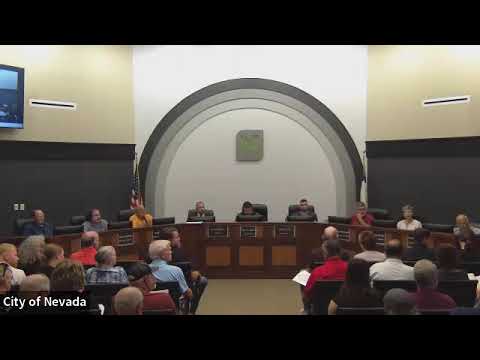
Residents from the Sampson Court and Indian Creek neighborhoods told the Nevada City Council on Tuesday that repeated sanitary-sewer backups over the last two years have caused extensive property damage and a heavy financial burden.
"For 22 years of living there, we've never had a sewer problem. Now the last two years, we've had sewer backup in our basement," resident Matt Rhodes said during the public forum, describing multiple houses in his neighborhood that have been affected. Chris Henson later told the council the backups have forced him to remove finished floors twice and impose recurring repair costs on his blended family. Jim George said the intrusion was "real personal," and told the council his basement suffered "over $1,225,000 dollars worth of damage" during the flooding.
Why it is happening: staff and the city's consulting engineer said last year's smoke-testing identified multiple sources of inflow and infiltration along the Indian Creek trunk line — including manholes with broken seals and holes in the side of the structures — that allow stormwater to surcharge the sanitary system during heavy rain. "We found manholes that had holes in the side, a few cross connections with the storm sewer," the city engineer said, describing repairs already underway on the Indian Creek trunk line.
Capacity and alarms: operations staff said the new lift station at 15th and H calls the operator when a high-level alarm trips and that, with all four pumps operating, the station can move about "6,000 gallons per minute." Still, staff and council members agreed that extraordinary rainfall events can overwhelm local systems. Kevin, the wastewater supervisor, told the council that the plant saw "8,000,000 gallons that came through the plant on that day" compared with normal flows of roughly 1.3–1.5 million gallons, and that the city continues to work on infrastructure upgrades.
Council action and next steps: the council approved change order No. 2 to an ongoing trunk-line manhole rehabilitation project to address additional damaged structures discovered during the storm, adding $12,070 to the contract. Several council members also urged pursuing a more detailed hydraulic model and additional flow monitoring to identify pinch points, and suggested issuing an RFP for an independent engineering audit to provide a third-party assessment.
What residents asked for: neighbors requested clearer documentation of pump and lift-station capacity and availability of high-water alarms, asked for inspection logs and records, and pressed the council to pursue remedies and compensation options for damaged properties. City staff acknowledged many technical details are still being gathered and said they will return with cost estimates and the results of further inspections and modeling.
Why it matters: repeated sanitary backups pose public-health risks, impose repair costs on homeowners and can indicate systemic failures in aging sewer infrastructure. Council members said the fixes will be expensive and take time but emphasized the city must move beyond smoke-testing toward calibrated hydraulic modeling, targeted repairs and ongoing flow monitoring.
What happens next: staff and engineers will collect pump specifications and flow data, consider an RFP for an independent hydraulic study, continue the trunk-line manhole repairs and report back to the council with findings and cost estimates.