Get Full Government Meeting Transcripts, Videos, & Alerts Forever!
Get email alerts on the Seattle Transit Measure topic
No spam. Unsubscribe anytime.
Seattle hearing draws dozens urging full funding for transit renewal; council to vote next week
Summary
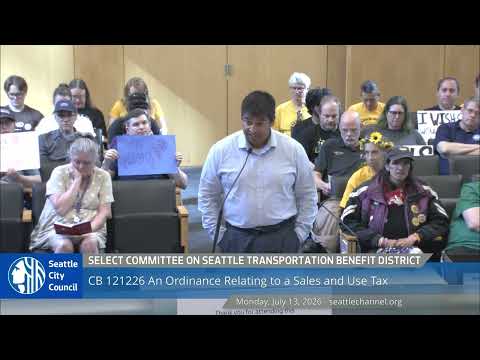
At an in‑person public hearing on July 13, dozens of riders, labor and housing advocates urged the Select Committee to advance a fully funded Seattle transit measure to the ballot and to reject amendments (notably 3, 4, 5 and 13) that speakers said would cut service or add burdensome approvals.
Chair Rob Sacca opened the Select Committee on the Seattle Transportation Benefit District’s July 13 public hearing and said committee members will continue deliberations at a follow‑up meeting on July 16 and expect full council action the week of July 21.
Public comment focused overwhelmingly on keeping the mayor’s proposed Seattle transit measure fully funded and directing most dollars to bus service. Commenters—riders, disability advocates, labor leaders, neighborhood groups and students—said modest household costs (widely cited in testimony as about $29 per year) would pay for more frequent, safer and more equitable transit across the city.
Cecilia Black, a wheelchair user and advocate with Non‑Drivers Alliance, called transit a “lifeline” and urged support for amendment 24 while urging rejection of amendments 13, 3 and 4, which she said would reduce service and worsen regressivity for people who cannot drive. “People with disabilities depend on transit,” she said.
Dennis Sills of the Downtown Seattle Association framed transit investment as economic infrastructure, citing the FIFA World Cup ridership surge and saying downtown businesses rely on reliable service. Greg Woodfield, president of ATU Local 587, pressed the committee to present a bold package (a 0.3% rate for 10 years, he said) without annual council approvals or redirects that he warned would disrupt service and workers’ livelihoods.
Multiple advocates emphasized night and weekend service, access to ORCA passes for low‑income residents and support for amendments that would guarantee a high share of funding for service (commenters repeatedly named amendments 10, 11, 17 and 29 as supports). Speakers representing housing providers and disability organizations also urged prioritizing access and said reporting requirements should not be used to delay delivery.
A number of commenters opposed amendments they characterized as creating extra process or cutting funding for service, repeatedly naming amendments 3, 4, 5 and 13. Transit advisory and rider groups (including TAB and the Transit Riders Union) urged rejection of annual sign‑off requirements and any cuts that would reduce the measure’s capacity to expand frequency and late‑night service.
Councilmember Strauss told the committee he will pull amendment 8 (contracted transit shuttles) after receiving assurances that the existing Hope Link contract would continue to provide specific shuttle service.
The chair closed the in‑person public portion after a roughly 90‑minute comment period and reiterated the next steps: the committee will reconvene July 16 to consider amendments and vote on a final package to send to the full council for possible approval July 21 to place the measure on the November 3, 2026 ballot.
The hearing produced no formal motions or committee votes; public testimony will be part of the committee’s record ahead of its July 16 meeting.