Get Full Government Meeting Transcripts, Videos, & Alerts Forever!
Get email alerts on the Invasive Plants topic
No spam. Unsubscribe anytime.
Chad Hammer urges early detection and prevention to limit damage from invasive plants
Summary
Chad Hammer, invasive plant biologist with the Maine Department of Agriculture, Conservation and Forestry's Natural Areas Program, outlined how invasive plants arrive, spread and damage habitats and infrastructure, and urged monitoring, equipment hygiene and early reporting to limit costly long-term control.
Chad Hammer, an invasive plant biologist with the Maine Department of Agriculture, Conservation and Forestry's Natural Areas Program, outlined how non-native plants arrive, spread and ultimately degrade habitats, water quality and fisheries in a recorded presentation. He emphasized that early detection and prevention are far less costly than long-term containment.
Hammer said federal and Maine definitions of 'invasive species' focus on non-native organisms that cause economic, environmental or human-health harm and can establish and spread in minimally managed habitats. "Out of every 100 exotic species introduced to North America, about 10 become established," he said, and "only about 1% can really establish in minimally managed habitat and become very weedy." He used those figures to underline that while relatively few introductions become invasive, those that do can expand rapidly and are costly to control.
Describing how invasives arrive, Hammer cited research indicating roughly 60% of introductions were deliberate and noted horticulture accounted for about 40% of those cases; smaller shares resulted from livestock forage plantings, conservation plantings and medicinal plant use. He also listed accidental pathways including contaminated hay and packaging, ballast materials and fill.
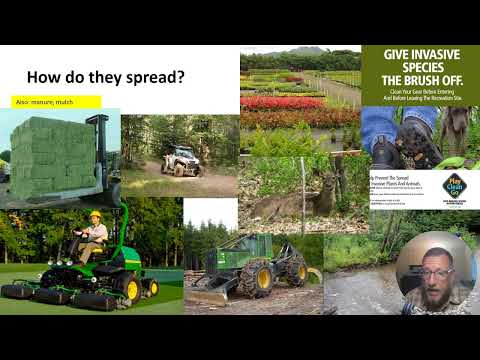
Hammer described common landscape vectors for spread: contaminated forestry and mowing equipment, ATV and skid trails, mulch and gravel, seeds that hitchhike on boots or pets, and downstream movement by water after culvert or fill work. "When you do any type of disturbance," he said, "you ramp up the likelihood and intensity of invasion."
He explained biological traits that make some species successful invaders, including aggressive above- and below-ground growth, allelopathic chemicals that alter soil biology, and an extended leafing period that lets invasives leaf out earlier and retain foliage later than native plants. Using local examples, he pointed to dense stands of Japanese knotweed along riverbanks, oriental bittersweet topping trees in Cape Elizabeth, and hardy kiwi in Rockland as illustrations of monospecific dominance that suppresses native regeneration.
Hammer tied those vegetative changes to measurable aquatic impacts: dense riparian monocultures create bare mineral soil and reduce groundcover, increasing runoff, erosion and embeddedness (siltation) in streams. That embeddedness destroys habitat for stoneflies and mayflies, key trout prey, and harms cold-water fisheries. He gave a concrete food-web example: black-capped chickadee parents may need roughly 6,000'to—9,000 insects across a brood-rearing period, and invasive-driven insect declines can undermine bird survival.
On management, Hammer stressed prevention and rapid response. Recommended practices included frequent monitoring after disturbance, cleaning equipment before and after entering sites, carrying boot brushes, and prioritizing control efforts where eradication remains possible. "If you catch it early, eradication is still possible," he said; "as time goes on, control costs go way up and success becomes impossible."
Hammer provided reporting resources and contact information for follow-up: IMAP'Invasive reporting tools, the Invasive Plant Academy tutorials, NFInvasives for early detection priorities, and his email chad.hammer@maine.gov for questions or reports.
He closed by urging landowners, managers and contractors to be mindful of plant material movements, to adopt basic hygiene practices and to report suspected new infestations so that early detection and rapid response can be deployed while eradication is still feasible.