Get Full Government Meeting Transcripts, Videos, & Alerts Forever!
Get email alerts on the Solid Waste topic
No spam. Unsubscribe anytime.
Weare select board drops proposed clear-bag rule, pauses new commercial-hauler permits after heated hearing
Summary
After a lengthy public hearing with dozens of residents and business owners weighing in, the Weare select board voted to remove a proposed requirement for clear/translucent household trash bags from the draft solid-waste ordinance and to pause issuing new commercial-hauler permits while DPW studies best practices and financial impacts.
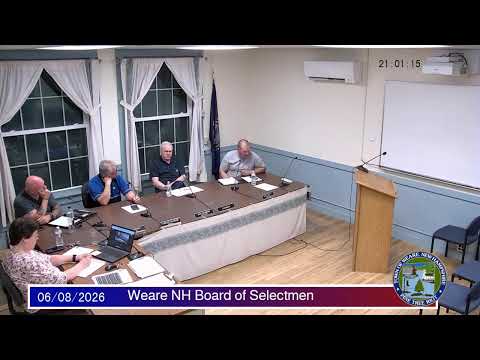
The Weare select board voted on June 8 to remove a proposed requirement that residents use clear or translucent trash bags and to insert temporary language restricting new commercial-hauler permits after a lengthy public hearing and a presentation by the town’s DPW director.
The chair, Ahmed Gibbon, opened the public hearing on the draft solid-waste ordinance at 7 p.m. and gave the floor to DPW director Jason Fiske, who had recommended options to increase recycling and reduce trucking and tipping costs. Fiske said the town’s average recycling rate across six years, counting estimated glass, is roughly 24 percent and that the town spends about $300,000 a year on hauling and tipping roughly 2,500 tons of waste. “Whether clear bags are the solution or they’re not, whether commercial haulers are the solution or they’re not, we’d like to get everybody’s opinion on that,” Fiske told the board while reviewing recent tonnage and recycling trends.
Residents and business owners sharply contested the clear-bag idea. Todd Solar, owner of Paul Springs Camp Resort, said clear bags are not durable enough for campground barrels and argued commercial haulers who pay permits should be allowed to use the transfer station: “We haul this out of town and pay to get rid of it. When we pay that much in taxes…it doesn’t seem fair,” he said. Multiple residents raised privacy concerns about exposing household waste in clear bags and warned of enforcement problems, additional staffing burdens and added costs for households who would need to buy more expensive clear bags.
After hearing more than 30 speakers and reviewing a stack of emailed comments and petitions, select board member (speaker 2) renewed a motion to strike section 5.4 — the clause that would have mandated clear/translucent bags effective Jan. 1, 2027 — from the draft ordinance. The board held an initial vote earlier in the hearing that resulted in a tie; following the full public record the renewed motion passed.
The board also addressed commercial-hauler permits. Several public comments and written submissions urged limiting commercial access unless the town can verify that materials brought to the transfer station originate in Weare. The board voted to add draft language (section 3.2) stating that commercial haulers without a permit are not allowed and that no new commercial-hauler permits will be issued while DPW collects comparative data and best practices.
The board made clear the decisions are procedural changes to the draft ordinance rather than immediate criminal or penal enforcement: the clear-bag requirement was removed from the version the board will continue to refine, and new-permit issuance is paused pending further study. The board directed DPW staff to gather comparative information from nearby towns, provide cost estimates for enforcement and operations, and return with a recommendation.
What happens next: DPW will gather data, including pre/post–COVID recycling trends and best practices from surrounding towns, and return to the board with staffing and operational cost estimates. The proposed ordinance language remains under revision; the board asked staff to prepare clear, public-facing answers to the questions raised during the hearing about costs, bag availability and enforcement.
Votes and formal actions: The board carried the motion to remove the clear-bag clause from the draft ordinance and voted to insert temporary language pausing new commercial-hauler permits and forbidding unpermitted commercial hauling pending further analysis.