Get Full Government Meeting Transcripts, Videos, & Alerts Forever!
Get email alerts on the Small Cell Installation topic
No spam. Unsubscribe anytime.
Adjoining property owner objects to Verizon small‑cell pole placement in New Canaan; applicant cites utility constraints
Summary
At a PURA evidentiary hearing on Cellco/Verizon’s proposal to install a small‑cell antenna in New Canaan, adjoining owner Gavin Marocco objected to placing equipment on a pole next to his home, calling the installations inequitably distributed; applicant witnesses said utility-owner rules, pole elevation and a make‑ready review with Eversource limited feasible alternatives and offered painting as a mitigation, which Marocco declined.
An adjoining property owner told the Public Utilities Regulatory Authority on Thursday that he objects to the placement of a proposed Verizon small‑cell wireless installation because the company singled out the pole adjacent to his home rather than distributing sites more evenly along the road.
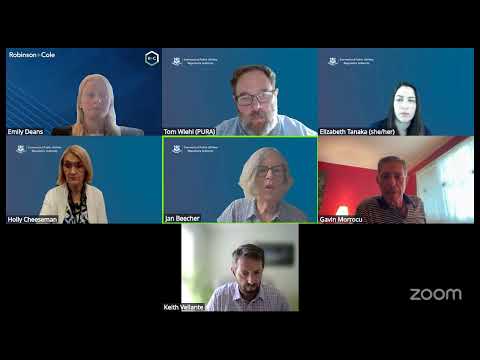
Commissioner Jan Beecher presided over the evidentiary hearing in PURA docket 260312, which concerns Cellco Partnership, doing business as Verizon Wireless, and an application to construct small‑cell wireless facilities in the public right of way in New Canaan. Attorney Emily Deans, representing the applicant, said SELCO has submitted required construction plans and RF exposure calculations and argued the application meets the authority’s standards and federal limits.
Why it matters: If the authority approves the application, Verizon’s equipment would be installed on a utility pole in a residential area. Adjoining owners can raise aesthetics and distribution concerns during the regulatory review; the authority must weigh those concerns against federal limits on radio‑frequency authority and the technical constraints reported by the applicant.
The objection and applicant response
Adjoining owner Gavin Marocco told the authority that his objection was not to the installation itself but to "an even distribution of these installations." Marocco said there are "45 electric poles on Wahakmee Road," with 28 beyond his house, 14 before it and three adjacent to his property, and said he could not understand why the pole next to his back patio was chosen.
Deans said SELCO had followed internal RF‑engineering procedures and noted prior PURA decisions and federal law limiting state regulation of RF emissions. She also described a mediation offer made during the review process: "We spoke with Mr. Marocco and with PURA's Office of Education, Outreach and Enforcement," Deans said, and SELCO "made an offer to paint the equipment adjacent to Mr. Marocco's property" to address his aesthetic concerns; Marocco declined the offer.
Technical constraints cited by applicant
Liz (Elizabeth) Glidden, identified in the record as Verizon’s real‑estate and regulatory specialist for the small‑cell program, described how engineers identify an "area of need" for coverage and then review which utility poles can be used. She said poles with risers, junctions or transformers often cannot be used, and that utility agreements and pole elevation limit mounting options. "We are not allowed to go above primary power with the utilities," Glidden said, describing the sidearm or cantenna mounts that would be required on poles with primary power and the make‑ready process in which a utility (Eversource) surveys and clears a pole or replaces it if needed. She said both Verizon and Eversource reviewed the identified pole and "found it ... could accommodate our equipment" with certain modifications.
Record and next steps
Attorney Deans enumerated five record exhibits, including the original application (filed 03/12/2026), an updated application (07/10/2026), and responses to interrogatories (06/04/2026 and 06/11/2026), plus pre‑filed testimony (06/26/2026). Marocco confirmed he had submitted correspondence and photos to the docket and adopted those filings as part of his testimony.
PURA asked whether parties would file briefs; SELCO said it will. The authority tentatively scheduled a decision for Oct. 7. The hearing was adjourned.
What was not decided
No formal motion or vote was recorded at the hearing; the authority will issue a written decision on the docket after the record is complete. Marocco’s equity and distribution concerns remain in the record; the applicant’s mitigation offer (painting) was rejected by Marocco and is not a binding condition absent inclusion in a final order.
Speakers quoted or attributed in this article appear as recorded in the hearing transcript and are limited to those who self‑identified or were introduced on the record.