Get Full Government Meeting Transcripts, Videos, & Alerts Forever!
Get email alerts on the Healthy Soils topic
No spam. Unsubscribe anytime.
CDFA outlines tribal-focused Healthy Soils solicitation, sets aside roughly $5 million for tribes
Summary
CDFA officials outlined a tribal-focused Healthy Soils solicitation funded by Proposition 4 Climate Bond funds, saying the Climate Bond authorized $65 million for Healthy Soils and CDFA has reserved about $5 million for a tribal-only solicitation; CDFA seeks tribal input on practices, data sovereignty and administrative barriers.
The California Department of Food and Agriculture on a recorded tribal listening session introduced a tribal-focused solicitation of its Healthy Soils Program and said the Climate Bond has authorized $65,000,000 for the program, with CDFA reserving about $5,000,000 for a solicitation dedicated to California Native American tribes.
"The Department of Food and Agriculture is pleased to provide an overview of 2 new grant programs," Thea, CDFA tribal liaison, said at the start of the session, explaining the purpose of the consultation and an August virtual roundtable.
Grace Chang, CDFA Healthy Soils staff, said the department plans regional listening sessions from August through October, will release draft application guidelines for public comment in November, aims to finalize guidance in December, and is targeting a solicitation launch in January 2027. Chang said the Healthy Soils program supports farmers and ranchers to adopt practices that improve soil health, reduce greenhouse gas emissions and sequester carbon.
Chang listed program mechanics and applicant requirements: there are 29 eligible practices (some supported for up to three years; others are one-time implementations such as permanent plantings), individual on-farm projects are capped at $150,000, and block grant recipients may be reimbursed for administrative and technical assistance up to 20% of the total award. Applicants must use CDFA’s online project design and reporting tool to map practices, document acres and estimate greenhouse gas emission reductions.
The presentation introduced a culturally tailored practice for tribal applicants described in the session as "cultural burning," and Chang said CDFA has consulted with CAL FIRE and tribal participants while developing practice requirements and related guidance.
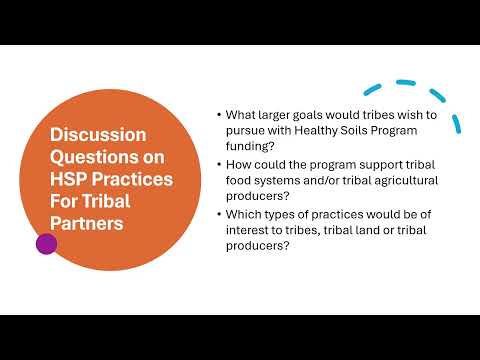
CDFA asked tribal governments and tribal organizations to weigh in on three topics during consultation: whether program goals align with tribal priorities; data-sensitivity and data-sovereignty concerns; and administrative or payment-structure barriers that could hinder participation. The consultation period is open through Sept. 4, and CDFA said it will hold additional regional listening sessions and a virtual roundtable on Aug. 13.
Thea closed by offering contact information for further consultation and said those needing extra time could reach out to Virginia Jamieson, CDFA’s deputy secretary for climate and working lands. The consultation is intended to shape program design ahead of the planned solicitation.