Get Full Government Meeting Transcripts, Videos, & Alerts Forever!
Get email alerts on the Cfd1 Staffing topic
No spam. Unsubscribe anytime.
Commissioners back full staffing increase for Consolidated Fire District No. 1 amid mill‑levy concerns
Summary
Douglas County commissioners expressed majority support for a supplemental request to add 10 FTE to Consolidated Fire District No. 1, citing operational need and recent incidents, while debating how to treat onboarding and PPE costs and the mill‑levy impact ahead of a July 15 mill decision.
Chair opened the hearing and heard a presentation from department staff on a supplemental request to add about 10 full‑time equivalent positions to Consolidated Fire District No. 1. Presenter outlined three options: A (full staffing with 6 firefighters, 3 captains and 1 chief officer), B (9 positions deferring the chief officer) and C (baseline stabilization adding six firefighters only).
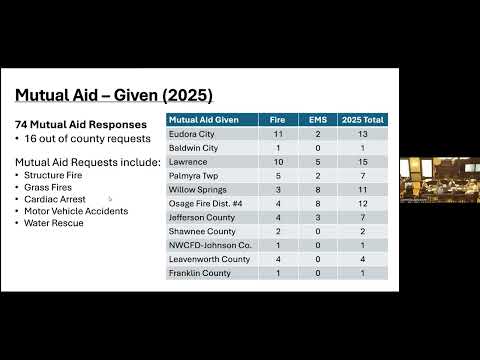
Presenter said the district handled roughly 1,000 incidents in 2025, of which about 676 were low‑acuity and roughly 312 were high‑acuity; fire calls constituted about 32% of incidents and medical calls about 67%. The presenter also described roughly 74 mutual‑aid responses in 2025 and noted that some mutual‑aid activations are automatic through CAD.
Chair said, "I'm supportive of the the full increase and the full ask of 10 positions," citing the district's large geographic area, strained volunteer force and recent large incidents that revealed capacity gaps. Multiple commissioners voiced concurrence that the full package would stabilize service and allow for more consistent programming and coverage.
Other commissioners raised concerns about the immediate mill‑levy impact. One commissioner proposed a middle ground between options B and C (described in the meeting as "B and a half") to add the six firefighters plus a chief officer now and phase in additional leadership later. Commissioners also debated whether onboarding costs for PPE, radios and bunker gear should be treated as a one‑time expense or wrapped into the ongoing mill levy; staff clarified the onetime onboarding line appears separately in the spreadsheet but that the mill calculation as presented assumed ongoing costs tied to the levy.
Agency staff explained the operational tradeoffs: captains provide 24/7 on‑shift supervision and take on fleet, training and program management, while a chief officer adds capacity for pre‑planning and community risk‑reduction programs. Several commissioners said the practical difference between options A and B is small in the long run and favored moving toward full staffing to avoid prolonged phasing uncertainty.
Chair summarized that a majority of the commission supported the full staffing request but asked staff to reconcile the spreadsheet math and return a final mill‑levy figure for the July 15 meeting. Staff agreed to update the sheets and follow up with the commission before the next deadline.
The commission did not take a formal vote during this session; next procedural steps are staff verification of the numbers and a mill‑levy decision at the July 15 meeting.