Get Full Government Meeting Transcripts, Videos, & Alerts Forever!
Get email alerts on the Energy And Geothermal topic
No spam. Unsubscribe anytime.
San Miguel draft aligns oil, gas and geothermal rules with state ECMC; setbacks, notices and deep‑geothermal rules drawn
Summary
County staff proposed draft rules to align local review of oil, gas, seismic testing and deep geothermal with the state ECMC framework: 2,000‑foot well setbacks from sensitive uses, seismic‑testing notification requirements, administrative review for certain activities and a separate deep‑geothermal permit for resources deeper than 2,500 feet. Staff and ECMC scientists urged coordination and reliance on state technical standards.
San Miguel County staff on July 9 presented a package of draft land‑use code changes to regulate oil and gas operations, seismic testing and deep geothermal activity in line with the new Colorado Energy and Carbon Management Commission (ECMC) framework.
"COGCC became ECMC…that was a very significant change," staff (Speaker 2) told the planning commission, referring to state legislation that expanded the regulatory focus and local authority. Staff said the local rules now emphasize land‑use impacts such as traffic, noise, air quality, well setbacks and reclamation, even as ECMC continues to regulate subsurface operations.
Key proposals in the draft include: 2,000‑foot minimum setbacks for new wells from residences, schools, health care facilities and county‑owned trailheads; 500‑foot setbacks for compressor stations and similar facilities; and a 1,500‑foot public‑notice radius for major operations. Seismic testing would be administratively reviewed with an 800‑foot notice requirement for nearby properties.
The county also proposed a separate section for deep geothermal (Section 6‑6), defining deep geothermal resources as those accessed below 2,500 feet. Staff said deep geothermal applications would be reviewed under a two‑step planning commission and BOCC process, with applicants required to submit surface‑use agreements, technical feasibility and waste‑management plans, vibration and air‑quality monitoring, and revegetation/reclamation plans.
John Morgan of ECMC (Speaker 5), the agency’s geothermal lead, participated by phone and flagged two practical points: local staff should accept ECMC‑prepared permitting materials when they are substantially equivalent, and the county should consider how it will treat ancillary facilities such as flow lines and transmission connections, which often sit outside the drilled pad.
Industry representatives said deep geothermal is technically mature enough for local pilots and encouraged close coordination with ECMC. "I'm the lead geothermal scientist here," one ECMC scientist said during public comment, arguing that closed‑loop systems and binary (ORC) power cycles can contain fluids and minimize emissions.
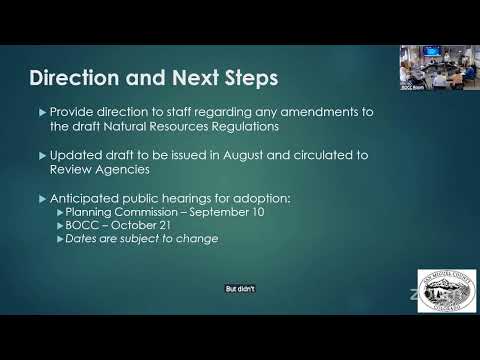
Commissioners asked staff to cross‑check setback and notification numbers with other county sections and to add a cumulative‑impacts screening for larger projects. Staff said they will incorporate ECMC and CPW comments and circulate revised drafts in August.
No permits were approved during the session; staff will return with refined language and specific thresholds for the commission’s consideration.