Get Full Government Meeting Transcripts, Videos, & Alerts Forever!
Get email alerts on the Forestry And Wildfire topic
No spam. Unsubscribe anytime.
San Miguel planners debate forestry-code changes as residents push for clearer wildfire exemptions
Summary
At a July 9 work session, San Miguel County planners reviewed draft Section 6-4 on forestry practices: staff proposed shifting regulation from timber volume to surface-disturbance thresholds and creating a general permit for qualifying wildfire-mitigation projects, while commissioners and residents pressed to clarify “property maintenance” and avoid burdens on private arborists.
San Miguel County planning staff on July 9 presented draft language that would rewrite forestry rules to regulate activities by area of surface disturbance rather than by timber volume, a change they said is meant to avoid hindering wildfire-mitigation work.
"We're adding a new section, 6‑4, forestry practices," said the county planner leading the presentation (Staff member, Speaker 2), describing a tiered system: qualifying wildfire-mitigation activities under a standing general permit, minor forestry by administrative review, and major forestry subject to a two-step planning commission and Board of County Commissioners review.
The proposal would exclude activities that disturb under a half‑acre from the forestry regime and treat them as property maintenance, allow qualifying wildfire-mitigation practices to proceed without county notification for small projects, and require notice of coverage for qualifying projects of 20–40 acres. Minor forestry would cover projects roughly in the 40–100‑acre disturbance range; major projects would be those with more than 100 acres of surface disturbance.
Commissioners and residents pressed staff to tighten definitions and reduce regulatory uncertainty for small landowners. "If it's just you with your chainsaw, and you're working on more than a half‑acre, more power to you?" one commissioner said, illustrating confusion about how the draft treats noncommercial property maintenance.
Tim Benno, CEO of the West Region Wildfire Council (Speaker 13), also urged caution about locking calendar dates into code. "March 15 through October 15," he told the panel, "…is not a hard and fast deadline" for beetle‑activity windows, adding that timing can vary by year and location and that landowners should be encouraged to consult the council or Colorado State Forest Service for best practice guidance.
Several commissioners fretted that requiring an administrative permit for many small lots would burden private arborists and county staff with frequent, routine filings. Staff and the consultant Tori Jarvis (Speaker 9) proposed several options: clarifying the property‑maintenance exclusion, raising the lower exemption from 1/2 acre to 1.5 acres, widening the scope of the general permit to cover more small wildfire‑mitigation activities, or waiving fees for administrative permits to reduce financial barriers.
Staff emphasized the draft’s goal of protecting water quality, wildlife and slopes while allowing wildfire mitigation to proceed: applicants would be required to show mitigation, revegetation plans, best‑management practices and referral‑agency coordination where appropriate. The planning director said the department welcomes materials prepared for federal and state permits to avoid redundant studies.
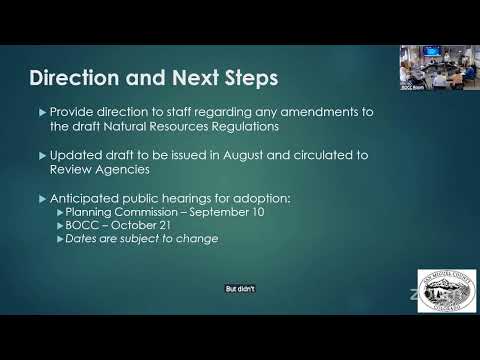
Next steps: staff will revise definitions for "property maintenance" and "surface disturbance," consider the SSR committee input and return a redraft for public review in August. The planning commission hopes to hold a hearing in September and to forward final recommendations to the Board of County Commissioners in October.
The session did not include formal votes on the amendments; commissioners asked staff for language options and a clearer checklist that would minimize unnecessary filings for homeowners and small contractors.