Get Full Government Meeting Transcripts, Videos, & Alerts Forever!
Get email alerts on the Municipal Solar topic
No spam. Unsubscribe anytime.
Municipal energy managers hear Solar 101: PV basics, procurement timelines and financing options
Summary
Presenters walked municipal staff through PV components and system types, recommended procurement steps and timelines (12–24 months), ownership vs. third‑party PPA tradeoffs, and case studies illustrating costs and savings.
Jeremy Ku (MAPC) and Chad Laurent (Cadmus) provided a practical Solar 101 for municipal energy managers, covering how PV systems work, typical municipal system sizes, procurement steps and ownership/third‑party financing options.
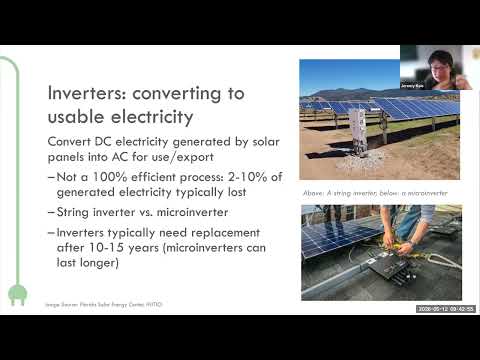
Ku outlined technical basics — how PV cells and modules generate DC electricity, the role of inverters to produce AC and common inverter types (string vs. microinverters) — and advised municipalities to budget for inverter replacement mid‑life. “When we talk about solar, we’re only talking about, solar, photovoltaics or PV,” Ku said, and offered a Massachusetts production rule‑of‑thumb: “If you have 1 kilowatt of PV, then that's on a good site, you'll usually get about 1,200 or 1,300 kilowatt hours per year generated by that.”
Laurent focused on getting started: set goals, quantify current and future electricity use, identify internal and external project staff, engage stakeholders early, and choose a procurement pathway. He recommended forming a core project team (sustainability/energy staff, facility managers, finance/legal, first responders) and, when helpful, hiring an owner's agent to manage RFPs and evaluation. For timing, he estimated roughly 12–24 months from initial site selection to operation, noting supply‑chain and permitting can lengthen schedules.
On financing and ownership, Laurent compared municipal ownership (needs upfront funding, greater long‑term savings but requires O&M and monitoring) with third‑party ownership/PPA models (developer pays upfront, owns tax incentives, provides credits to municipality under a long‑term contract). He described PPAs as typically 20‑year arrangements where the developer claims incentives and the municipality receives a discounted value of on‑bill credits; the municipality benefits from lower upfront cost but shares incentives with the third party. Laurent illustrated with case studies (Lexington, Newton, Winchester) that showed system sizes of several hundred kW and multi‑million dollar project costs with long‑term savings projections.
Speakers urged municipal teams to collect site data (roof age, warranties), evaluate electricity rates and demand charges, and include performance guarantees in contracts or procurement specifications. The session closed with Q&A and resources for further technical and procurement assistance.