Get Full Government Meeting Transcripts, Videos, & Alerts Forever!
Get email alerts on the Municipal Budget topic
No spam. Unsubscribe anytime.
Forest Park council weighs "places of eating" tax and orders staff to study revenue package
Summary
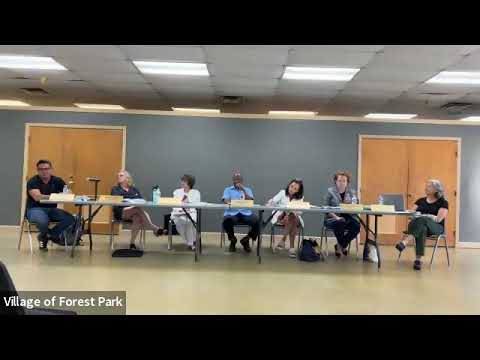
Facing a shrinking general fund, the Forest Park Village Council spent a budget session debating a proposed "places of eating" tax and a suite of alternatives — streaming/amusement taxes, short-term-rental rules, parking changes and TIF-funded economic development — and directed staff to research implementation details and hold business outreach.
Council members spent a budget work session debating how to close a growing general-fund shortfall and directed staff to pursue research and outreach on several revenue options, including a proposed places-of-eating tax that some members said could generate meaningful near-term revenue.
The discussion opened with the Council Chair warning that unsolicited development proposals will surface if the village does not clarify its process for handling offers near transit nodes and noting that multiple revenue options should be explored. The Chair asked staff to keep business owners "in partnership" while preparing any proposals and to defer a final decision on timing until research and outreach are complete.
Why it matters: Council members reviewed fund-balance projections that show the general fund eroding since 2023, which proponents said creates pressure to find immediate revenue. Opponents and cautious members warned that some proposals — especially a places-of-eating tax — could disproportionately affect small, independent restaurants that already face tight margins.
Committee member (Speaker 2) emphasized the immediacy of the shortfall, citing the village's fund-balance trajectory, and urged the council to act. "We do this every single budget meeting," she said, arguing the village lacks another clear, immediate revenue source. She framed the places-of-eating tax as a known option compared with uncertain litigation proceeds or speculative grants.
Other members sought compromise measures to reduce the burden on local businesses. One council member (Speaker 4) proposed a graduated approach that would allow businesses to pass the charge to patrons and offset the impact by revisiting local license and permit fees, including sidewalk-use and liquor-patio permits, to create a net balance.
Several council members and staff also recommended pursuing a package of smaller or restricted measures: a streaming/amusement tax (using model ordinances the staff referenced), regulation and registration of short-term rentals to recover enforcement costs, revising on-street parking hours and overnight-parking permits, and targeted economic-development work funded from existing TIF dollars, including façade grants and hiring a consultant to recruit sales-tax-generating businesses.
Staff confirmed a workplan. "Hearing no objections, I'll continue to do the research on that," the Staff member (Speaker 5) said, summarizing that staff will draft educational materials and hold a meeting with businesses if the council moves forward with a places-of-eating tax; will study a streaming-tax model ordinance and short-term-rental registration; and will analyze parking-meter hours and TIF investments to generate revenue without immediately increasing the general fund's tax levy.
What was not decided: There was no vote or ordinance introduced at this meeting. The council repeatedly emphasized that any places-of-eating tax or similar levy would be vetted with business owners and that implementation timing would be deferred until staff returns with data and an outreach plan. Staff warned that some funding streams (for example, a hotel/lodging tax) are restricted in use and would not directly offset the general fund.
Next steps: Staff was directed to return with research, revenue estimates and an outreach plan; the next formal budget meeting was noted for July 22. The council also discussed using TIF funding in FY2028 for economic-development consulting and facade grants to support local businesses as part of the revenue strategy.
Ending: The session closed with the Chair thanking business owners and the chamber for participating and adjourning the revenue discussion.