Get Full Government Meeting Transcripts, Videos, & Alerts Forever!
Get email alerts on the Housing Development topic
No spam. Unsubscribe anytime.
Ashland planning board delays Mill Pond housing decision after residents raise contamination, road‑safety concerns
Summary
The Ashland Planning Board continued the public hearing on the Mill Pond affordable‑housing application after extended public comment about historic contamination, proposed road waivers and access concerns; a site visit was scheduled for March 23 (noon) and the hearing continued to April 3 (6:30 p.m.).
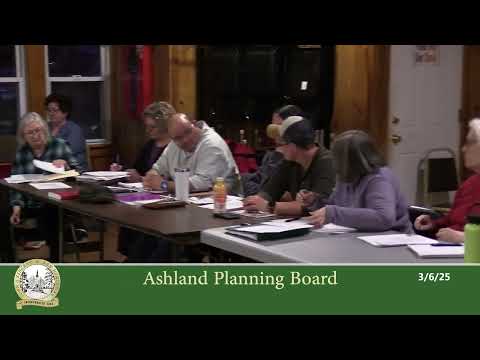
The Ashland Planning Board voted unanimously on March 6 to continue the public hearing on the Mill Pond affordable‑housing project and to hold a site visit Sunday, March 23 at noon before reconvening the hearing on April 3 at 6:30 p.m.
The developer’s representative told the board the application packet filed March 4 included full plan sets, a drainage report, sewer calculations, a fire‑truck turnaround plan, a traffic study and a revised waiver request for Mill Pond Lane. The applicant is seeking a waiver from some subdivision road standards to build a 22‑foot paved lane with 2‑foot gutter/paved shoulders and a closed drainage system with catch basins that would direct runoff through gravel wetland treatment before outfall to the river. “We’re proposing a closed drainage system so we can capture the water in catch basins, route it to an outfall,” the presenter said. He said routing through gravel wetlands would reduce phosphorus, nitrogen and total suspended solids before water reaches the river.
Why it matters: Neighbors and residents said the road‑width waiver, sidewalk placement, and potential soil disturbance near the pond raise safety and environmental risks, and several speakers urged the board to wait for more environmental data before granting design exceptions. The board declined to decide on the waiver that night and directed staff and the town’s engineer to review the materials and report back.
Public health and contamination concerns were the evening’s dominant theme. Several residents cited prior industrial uses and alleged buried waste. Frederick Walsh, who said he had served as the town’s cemetery official, urged a full investigation and cautioned against allowing digging until state and town engineers complete a survey. “There is a tremendous amount of material that’s buried in there,” Walsh said, urging that the site not be disturbed until the Department of Environmental Services (DES) and qualified investigators have evaluated the property. A resident with former paper‑mill experience said he believed mercury was present: “There is absolutely mercury in the soil there,” he said, and warned that disturbing soil could release contaminants.
The applicant responded that remediation and protections are part of the plan and that an activity/use restriction would be recorded in the deed to limit certain disturbances; the presenter said the developer intends to clean or cover contaminated areas as part of the project. “What we are proposing, we’ll clean up the site,” a project representative said, adding the proposed design would reduce exposure pathways compared with the current condition.
Board members and counsel advised that the planning board’s authority is limited to town subdivision, site‑plan and zoning rules, and that DES is the principal regulator for historical contamination remediation. “State Department of Environmental Services is going to be very involved in these environmental issues,” a board member said, and noted the board’s jurisdiction does not extend to regulating hazardous‑waste cleanup.
Other technical points discussed included alternatives to a traditional cul‑de‑sac (a hammerhead turnaround was proposed as an option to accommodate the dam operator’s heavy equipment), coordination with the electric department to place utilities underground, and questions about road right‑of‑way and retaining walls to minimize shoreline impacts. Neighbors asked how school buses would serve students with special‑education transportation needs; the presenter said road and loop designs were sized for wider vehicles but that bus routing and operations would be determined by the school district.
The board approved a procedural motion to continue the hearing, schedule the on‑site visit for March 23 at noon and reconvene on April 3 at 6:30 p.m.; the motion was seconded and passed by voice vote. No final decision on any waiver or plan approvals was made.
Next steps: Town staff and the board’s third‑party engineer will review the submitted materials and the applicant said Brown Engineering and other consultants will submit further responses; LRCD’s financial‑impact consultant was expected within two weeks. The DES process and the pending Phase‑2 (Level‑2) environmental assessment remain central outstanding items residents say must be resolved before the board takes substantive action.