Get Full Government Meeting Transcripts, Videos, & Alerts Forever!
Get email alerts on the Education Accountability topic
No spam. Unsubscribe anytime.
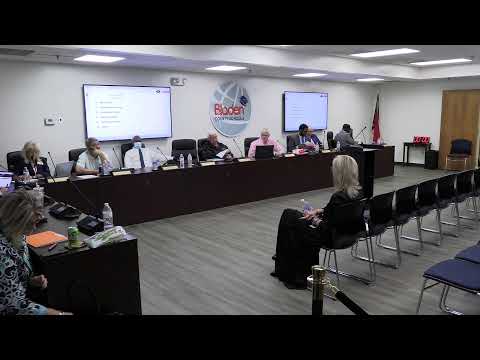
Bladen County Schools highlights mixed 2024–25 test results and presses state on retesting policy
Summary
Superintendent and district staff presented 2024–25 accountability results showing growth in many schools but multiple state-designated low-performing campuses; the board debated the state's 80/20 test-weight model and urged broader retesting options and funding for interventions.
Dr. Atkinson and district testing director Mr. McCarthy presented Bladen County Schools' 2024–25 accountability report, outlining gains in English learner (EL) progress and special education subgroups alongside several schools that remained labeled as low performing under the state's school-performance formula.
The presentation noted large year-to-year increases for some measures: Bladen Lakes Primary raised math proficiency and EL progress, Elizabethtown Primary doubled EL progress (from 24% to 50%) and improved special-education proficiency for students with disabilities from 7.8% to 26.3%, and Bladen Early College posted 100% proficiency in Math 3 and a 100% cohort graduation rate. At the same time, several schools received D or F letter grades, prompting federal TSI/CSI designations for particular subgroups at some campuses.
Mr. McCarthy said delays in state score releases prevented district-wide retesting in science and some end-of-course subjects; he estimated 94 students across elementary and middle grades were within five points of passing a science test and that retesting could have materially improved some school performance grades. McCarthy also showed a modeled outcome under a 50/50 achievement/growth weighting, which would have raised many schools' numeric scores and, in some cases, altered their state labels.
Superintendent Dr. Atkinson described the state's 80% emphasis on a single test day as "skewed," saying the current model undervalues classroom work and year-long growth. "We're putting 80% push on a single test score," he said, arguing the district is advocating with the state for a fairer model and for broader retesting windows that would allow remediation and retakes.
Board members pressed administration on concrete steps: who was offered retests last year, why some districts reportedly retested while others did not, and how the district will manage retesting options if state policy is changed. The administration said 3rd-grade reading has been complicated by an either-or choice between the Read to Achieve (RTA) option and an EOG retest; pending guidance from the state board could allow districts to give both assessments concurrently, permitting EOG replacement where applicable.
The presentation also addressed staffing and recruitment: several middle-school cohorts suffered from vacancies or long-term substitutes in tested subjects, notably math, which board members linked to significant achievement declines in specific grades. Administration described strategies to raise proficiency without large new funding: targeted PLC (professional learning community) collaboration, cross-school lesson-plan sharing, quarterly student-led data conferences, and targeted, in-school high-dosage tutoring.
The board did not take action during the information item but asked that the data and the district's testing plan be shared with county commissioners and used to support budget requests. Dr. Atkinson said he will update the board after an upcoming meeting with the state superintendent about retesting and potential state-board policy changes.