Get Full Government Meeting Transcripts, Videos, & Alerts Forever!
Get email alerts on the Equity Priority Buildings topic
No spam. Unsubscribe anytime.
Committee approves release of rental affordability requirements for public comment, advances two-tier equity-priority framework
Summary
A city advisory committee voted to release rental affordability requirements for public comment and discussed a two-tier definition for equity-prioritized buildings that would prioritize low-income properties for assistance and outreach; the committee also reviewed local funding and a timeline for rulemaking and community engagement.
A committee advising on Evanston building policy voted to release proposed rental affordability requirements for public comment and advanced a two-tier approach to defining equity-prioritized buildings (EPBs).
The motion to publish the rental affordability requirements for public comment was moved by a committee member and seconded; the committee approved the motion by voice vote, with no formal tally recorded. After the vote, presenters continued a discussion of how EPBs would be identified and supported.
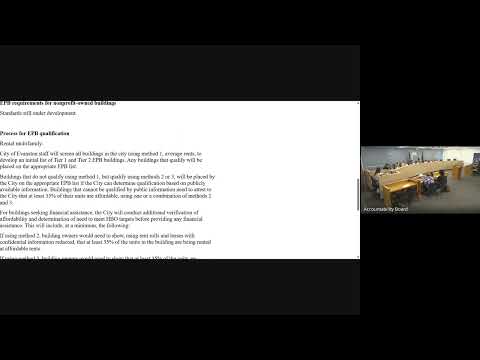
The presenter laid out a two-tier proposal. "We are recommending a 2 tiers system," the presenter said, describing Tier 1 as buildings affordable to households at about 80% of area median income (AMI) and Tier 2 extending up to roughly 120% AMI. Tier 1 properties would receive priority for financial assistance when funds are available; Tier 2 properties would be eligible for technical assistance and lower-priority supports.
The presenter described three qualifying methods for Tier 1: an average-rent test based on available rent data, a 35% threshold where 35% of units have combined rent-and-utility costs below the 80% AMI limit, or a 35% occupancy metric tied to households using housing tools such as vouchers. "We are, proposing a 35% number here at the recommendation of, city's house of staff," the presenter said when explaining how the proposal aligns with some Cook County programs.
Committee members and staff emphasized the proposal is intended as a starting point for public engagement, not a final ordinance. One member cautioned against promising supports the city cannot deliver and urged clear messaging during outreach.
Staff outlined existing local resources that could be tapped: Sustain Evanston grants that can provide up to $25,000 per eligible property, an approximately $300,000 pool with remaining funds, and the Evanston Green Homes pilot with about $250,000 available this year. Staff also highlighted a partnership with the Illinois Green Alliance building energy hub to provide technical assistance and resources.
Committee members noted the policy’s enforcement phase is starting with warnings. "So this year, we're issuing warnings," a committee participant said, describing the phased approach to enforcement while the city builds capacity to collect fines in later cycles. Committee members also said that fines for noncompliance are expected to be routed to an assistance fund for EPBs; staff said the allocation was shifted to 90% directed to EPB-support funds.
The committee directed staff and the technical committee to coordinate outreach and to return with additional materials, fact sheets and a public-engagement schedule to clarify how EPB designation translates into benefits. The group indicated further rulemaking work is scheduled through the fall and winter to inform potential ordinance amendments in the first quarter of next year.