Get Full Government Meeting Transcripts, Videos, & Alerts Forever!
Get email alerts on the County Budget topic
No spam. Unsubscribe anytime.
Douglas County commissioners set delinquency rate at 1.5% and preserve behavioral-health capacity in budget deliberations
Summary
On July 14, 2026, Douglas County commissioners agreed to use a 1.5% delinquency rate for mill-levy calculations and discussed several one-time funding requests—retaining roughly $953,776 in ongoing capacity in the behavioral health fund while flagging items for further review.
Douglas County commissioners continued their 2027 budget hearings on July 14, 2026, and agreed to use a 1.5% delinquency rate in the mill-levy calculation for upcoming R&R notices while preserving ongoing capacity in the county behavioral health fund.
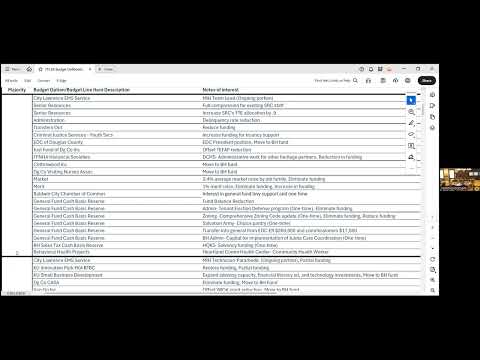
The chair opened the session and staff lead Sarah said the county’s "current capacity is just under 1,000,000 $953,776" in ongoing behavioral health fund capacity and noted staff is projecting about $7.2 million in sales tax revenue. Commissioners used those capacity estimates in weighing one-time and ongoing requests.
Commissioners debated several targeted one-time requests brought up in the packet. The HSE Financial Empowerment Program was funded as a one-time $20,000 allocation after commissioners decided not to commit ongoing dollars. On the request from the Baldwin City Chamber of Commerce, commissioners discussed whether small, one-time support or routing chamber requests through the county Economic Development Corporation (EDC) was appropriate; no final ongoing commitment was made.
On tenant-eviction defense, two commissioners recommended pausing or eliminating funding for the current pilot until outcome data are available. One commissioner said the pilot should be extended to 18 months to produce meaningful results; another noted that a private grant to Holistic Defenders has been used to defend eviction clients and urged staff to ask the pilot operator to provide more outcome data before cutting funding.
Commissioners also reviewed a planned comprehensive zoning code update, where staff estimated a one-time consultant maximum of $300,000. Some commissioners preferred hiring an outside consultant for the technical workload and comparators from other counties; others said in-house work would be slower but might save money.
A staff-requested item labeled in the packet as a social health access referral platform (referred to in meeting materials variously as "Gelada" or "Gelato") drew caution: several commissioners said stakeholders are not yet aligned on platform choice and recommended holding off on funding until partners reach consensus and an RFP or clearer vendor-selection process is established.
After discussing potential levers to lower the mill levy, including trimming one-time resources and adjusting the delinquency rate (options discussed included 2.0%, 1.5%, and 1.0%), the chair summarized the apparent consensus: "It sounds like we're going with 1.5% delinquency," and staff confirmed the spreadsheet and mill levy materials would be updated to reflect that decision. The commission asked staff to prepare R&R notices based on a 40.285 maximum mill levy and the agreed 1.5% delinquency rate.
Before adjourning, staff committed to calculate the county general fund reserve after today's decisions and to return with merit-pool recommendations and any outstanding clarifications. The commission adjourned the budget hearing for the day and scheduled reconvening at 9 a.m. the next morning.
The commission did not take a formal recorded vote on any ordinance or resolution during the session; most funding decisions discussed were allocations that staff will incorporate in the finalized budget materials and R&R notices.