Get Full Government Meeting Transcripts, Videos, & Alerts Forever!
Get email alerts on the Economy topic
No spam. Unsubscribe anytime.
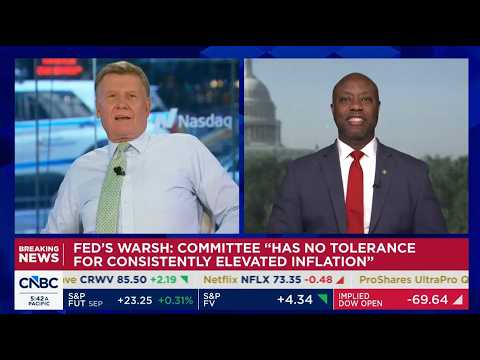
Sen. Tim Scott says more Americans are 'receiving more money,' credits Trump tax cuts and border policy
Summary
In a broadcast interview Sen. Tim Scott said more Americans are ‘‘receiving more money’’ under policies he credits to former President Trump, cited the 'working families tax cut bill' and defended border measures; panelists disputed his numeric claims.
Sen. Tim Scott, a Republican senator, told a broadcast panel that ‘‘more Americans are receiving more money’’ under policies he attributed to former President Donald Trump and that those policies make Americans ‘‘better off’’ than under President Joe Biden. Scott cited the ‘‘working families tax cut bill’’ and said it saved Americans ‘‘about $5,000,000,000,000,’’ which he added ‘‘translates into about $2.50 a month’’ and elsewhere characterized as roughly ‘‘$250 a month’’ for some people. He also credited Trump-era border actions with reducing costs tied to illegal immigration.
The senator framed the comparison as a broad contrast between the two presidencies, saying interest rates and inflation worsened earlier and that recent decisions have moved the country in the ‘‘right direction.’’ He urged listeners to "take the numbers and take a deep look at them" and to draw their own conclusions from available data. "Come to them based on the facts, not on our emotions," Scott said.
Panelists challenged Scott's presentation of the data during the interview. A Questioner-style panelist responded that on many standard measures — total federal debt, inflation, consumer prices and some employment indicators — there were figures that looked worse over the periods cited, and urged caution about selecting single point-in-time comparisons. The panelist said, "we have more debt, inflation numbers worse, consumer prices worse, unemployment is worse," and invited discussion of averaging across full presidencies rather than comparing specific endpoints.
Scott pointed to specific policy actions — including a $1.9 trillion spending package enacted at the beginning of the Biden administration — and said those measures left a steep set of headwinds that current policies are addressing. He described the net effect on household purchasing power and argued tax cuts and other moves at the federal level have returned money to Americans. Other panelists repeatedly pressed for clearer numeric framing and averaged metrics rather than point-to-point snapshots.
The interview did not produce independent verification of Scott's arithmetic. The panelists' back-and-forth illustrates competing ways to measure presidential-era economic performance (point-in-time measures at transitions versus multi-year averages). Several speakers used different reference points for gas prices, unemployment and inflation during the exchange; the interview transcript records disagreements over which comparison window is most appropriate.
The broadcast concluded without any formal outcome; the segment closed after further discussion and personal remarks.