Get Full Government Meeting Transcripts, Videos, & Alerts Forever!
Get email alerts on the Zoning topic
No spam. Unsubscribe anytime.
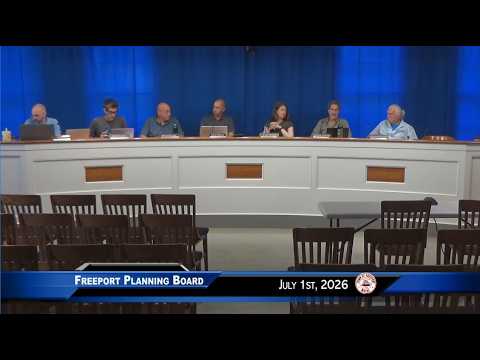
Freeport Planning Board recommends Town Council revise net-residential-acreage definition to avoid parking-driven density limits
Summary
The Freeport Planning Board unanimously recommended that the Town Council amend the town's net residential acreage definition so parking areas in multifamily developments are not deducted when calculating subdivision density, a change staff said would better align zoning with the comprehensive plan and allow more multifamily capacity along the Route 1 corridor.
The Freeport Planning Board voted to recommend that the Town Council amend section 104 of the Freeport Zoning Ordinance to change the definition of net residential acreage so that parking areas within multifamily developments are not subtracted from the parcel acreage used to calculate subdivision density. The recommendation followed a staff presentation and public hearing at the board's July 11 meeting.
Board members said the current practice of deducting parking areas from net residential acreage can artificially reduce density allowances and undercut recent zoning changes intended to allow more housing in commercial districts. "Subtracting the parking areas from developable land is sort of an artificial restriction on density," the board chair said during the hearing. Planning staff noted the change is intended to align the ordinance with the comprehensive plan's goal to encourage a range of housing types, including multifamily and townhomes alongside commercial spaces.
Kyle (planning staff) told the board the amendment would apply to both existing and future subdivisions and could, in some cases, allow developers to return for amendments if parking had been previously deducted. "The idea is that parking needs and wants can change over time," Kyle said, arguing that a fixed deduction can create a circular reference that penalizes certain multifamily designs. Members discussed alternatives such as using a gross-residential-acreage formula in growth areas or applying district-specific lot-coverage limits, but staff recommended the definition change as a clearer, ordinance-level fix.
The board opened and then closed a public hearing with no in-person or Zoom public commenters recorded. A member moved that the planning board recommend the Town Council adopt the zoning text amendment to amend section 104; another member seconded the motion and the board expressed unanimous support among members present. The formal motion cited consistency with the Town of Freeport comprehensive plan.
Board members asked whether property owners whose parcels would gain development potential would be directly notified; Kyle said the ordinance does not require retroactive mailings but staff would notify local development partners (for example, the Freeport Economic Development Corporation) and suggested targeted outreach could follow. The board also discussed examples such as Varney Heights and noted the amendment would not change density calculations for single apartment buildings that do not trigger subdivision review.
The Planning Board's recommendation will be transmitted to the Town Council for its consideration; the council will hold its own public process before taking final action.