Get Full Government Meeting Transcripts, Videos, & Alerts Forever!
Get email alerts on the Court Calendar Call topic
No spam. Unsubscribe anytime.
Judge Hayward processes multiple pleas, ready announcements and payment modifications in Clayton County State Court calendar call
Summary
At a virtual calendar call July 13, 2026, Judge Tammy Long Hayward accepted several negotiated pleas (including DUI and reckless-driving cases), scheduled many defendants for an in-person trial calendar on Aug. 10, and resolved suspended-sentence payment issues and bond-forfeiture items. Several continuances were ordered to allow discovery review.
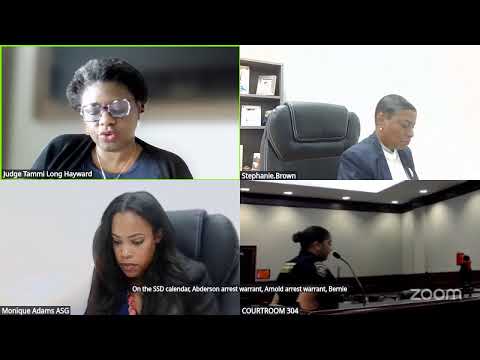
Judge Tammy Long Hayward opened the July 13 calendar call for Courtroom 304 of the Clayton County State Court, providing technical instructions for remote participants and explaining the day’s purpose: to determine which cases were ready for trial, continued or otherwise resolved.
The court accepted multiple negotiated pleas during the session. Defense counsel Owen Lynch told the court that Henry Lee Brown would plead guilty to specified DUI-related counts; the state presented a factual basis and recommended sentence, and Judge Hayward accepted the plea. The court imposed a 12-month sentence with 72 hours to serve (credit for time served), the balance probated, a $500 fine, 240 hours of community service (court text referenced 240 hours for one defendant and 40 hours for others; see case-specific orders), enrollment in a risk-reduction program, a substance-abuse evaluation with any recommended treatment, and random drug-and-alcohol screens. Judge Hayward explained probation reporting expectations and told Mr. Brown to provide medical documentation to probation if needed.
In a separate matter, Brian J. Davis pleaded guilty pursuant to a negotiated disposition to reckless driving (count 4). The state recommended 12 months with one day to serve, the balance probated, a $300 fine (about $444 with surcharges as calculated in-court), 40 hours of community service, a substance-abuse evaluation, and a risk-reduction course; Judge Hayward accepted the plea and directed Mr. Davis to meet the court’s probation expert for onboarding.
Omar Meshach Franklin and Lazarus Tashawn White each entered negotiated pleas on DUI-related charges. The factual bases the state gave included observed impairment, field-sobriety testing results and measured blood- or breath-alcohol concentrations (the transcript records a 0.116 BAC for Franklin). For both defendants the court imposed terms that included 12 months with one day to serve (credit for time served), balances probated, fines (examples: $300 or $500 depending on the case), 40 hours of community service, participation in risk-reduction programming and drug/alcohol evaluations, and random testing. The court directed defendants to connect with the probation office and follow program requirements.
The court also processed multiple traffic pleas and ready announcements: Tavares Hill pleaded guilty to a speeding charge (21–25 mph over) and was given 30 days to pay the fine (the judge provided payment instructions to the clerk’s office and asked defendants to submit contact details via the Zoom chat). Several other defendants and counsel announced “ready” for the in-person trial calendar set for Aug. 10, 2026.
Judge Hayward and solicitors discussed several discovery issues on cases where video evidence was outstanding or recently produced. In multiple instances the court directed defendants or defense counsel to obtain video discovery at the solicitor’s office, arrange in-person review, and agreed to move cases to the next available calendar to allow counsel time to review evidence.
The SSD (suspended-sentence) calendar and bond-forfeiture dockets were heard in the same session. On the SSD calendar, the court recorded payments, accepted a number of modification/extension requests and warned that arrest warrants would issue for missed deadlines; several defendants were instructed to make in-person payments at the clerk’s office or arrange alternate payment methods if out of jurisdiction. On the bond-forfeiture calendar the court entered rule-absolute and surety-related outcomes on multiple files and deferred others as counsel requested.
Throughout the hearing Judge Hayward repeatedly reminded remote participants to rename themselves with their first and last name, to remain muted until called, and to come to courtroom 304 in person on Aug. 10 if they had announced “ready” for the trial calendar. The judge closed by summarizing which matters were continued, which were resolved by plea or no-pros, which defendants were excused, and which items required further conference or follow-up with counsel.
What happens next: many matters will appear on the in-person trial calendar on Aug. 10, 2026; some plea dates were scheduled for future Zoom plea dockets (counsel and the clerk’s office will notify parties of exact dates). Defendants who accepted probation or payment modifications were directed to follow the instructions sent by the clerk and to report as required.
Representative quotes from the calendar call include Judge Hayward’s recurring instructions to remote participants: “Please make sure that you put your first and last name on the screen… If you don’t know how to do it, Google it,” and her admonition to probationers that “the quickest way to get rearrested is to fail to appear for your probation reports.”
The court’s proceedings were procedural and administrative in nature: pleas were accepted where negotiated, several cases were continued to allow discovery review, and the court provided clear next steps for probation intake and payment processing.