Get Full Government Meeting Transcripts, Videos, & Alerts Forever!
Get email alerts on the Parking topic
No spam. Unsubscribe anytime.
Council restores parking waiver for 1060 Madison after owner adds spaces; mayor retains authority to revoke
Summary
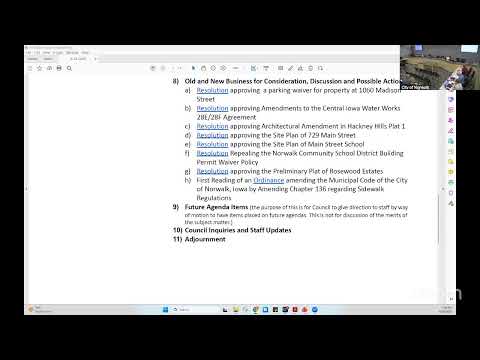
Council approved a parking-waiver resolution for Dunn Industrial Condominiums at 1060 Madison Street after planning and zoning recommended striping 30 additional spaces to raise capacity to 57 and an occupancy cap of 215; the owner warned stricter parking demands could jeopardize the business.
The City Council voted on June 18 to approve a resolution granting a parking-waiver for 1060 Madison Street (Dunn Industrial Condominiums) after the Planning and Zoning Commission recommended adding 30 striped spaces to meet a 57-space standard and set an occupancy limit of 215 people.
Staff explained the waiver stems from earlier approvals that limited the site to 27 spaces under a practices-only representation; subsequent activity and an event led staff to revoke the waiver on May 7 and refer the issue to Planning & Zoning. P&Z reviewed site options and recommended adding striping in loading-bay areas so the site meets the higher parking total while preserving drive-aisle and emergency access.
Owner-developer Jared Huisman addressed council by Zoom and said requiring 110 spaces would make the lease and business model infeasible and could lead to vacancy or foreclosure. "If you require a 110, then this building is going vacant," Huisman said, adding that owners face about $20,000 in monthly carrying costs. City staff and a PNZ member responded that the revocation was prompted by an event that exceeded the original practices-only representation and that P&Z’s recommendation to add 30 spaces was intended to address intermittent higher-occupancy uses.
The resolution approved by council includes that the waiver is not an entitlement and that the mayor retains authority to temporarily revoke the waiver for violations; it also makes the waiver effective only after issuance of a certificate of occupancy.
Why it matters: the decision balances code compliance and the viability of a private business using an industrial property for recreational or event uses; it also establishes conditions for future enforcement by the mayor.
Next step: the waiver becomes effective upon issuance of the building's certificate of occupancy; the mayor or council may revoke it if occupancy or parking demands exceed the agreed limits.