Get Full Government Meeting Transcripts, Videos, & Alerts Forever!
Get email alerts on the Opioid Recovery Housing topic
No spam. Unsubscribe anytime.
New Milford Council delays decision after heated debate over opioid-settlement housing voucher eligibility
Summary
Council members, public-health advocates and recovery providers debated whether recipients must hold a current New Milford address to qualify for a one-month opioid-settlement-funded housing voucher; speakers urged broader 'nexus' rules to avoid turning away people in crisis. Council asked the committee for a written eligibility definition and regional outreach before voting.
Mayor and the New Milford Town Council heard an extended public discussion on a proposed interpretation of eligibility for a town-funded “redemption housing” voucher program supported by opioid litigation settlement proceeds.
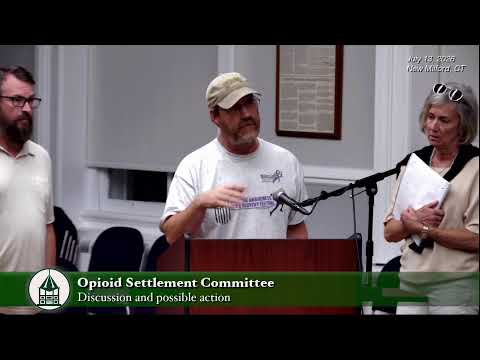
Tony Morrissey, a member of the opioid-settlement committee, told the council the program is designed as a crisis-to-recovery bridge and argued the town should interpret a “New Milford nexus” broadly so people without a permanent New Milford address can be screened and assisted. “This program is funded through the opioid litigation settlement proceeds, not New Milford property taxes,” Morrissey said, adding that housing is a recognized opioid-abatement strategy and that vouchers enable a short, intensive placement to stabilize people after treatment.
Allison Fulton of the Western Connecticut Coalition urged caution but also urged flexibility, citing local data: “Between 2020 and 2025 there were 23 overdose deaths that occurred in New Milford; 26 percent involved people who were not New Milford residents,” she said, arguing that overdose risk and service use cross municipal boundaries.
Councilors pressed the committee on logistics: how long vouchers last, where recipients would be placed and who would verify eligibility and follow-up. Committee members said the voucher is intended to cover an initial month (with many providers extending support) while recovery providers and case managers work with recipients to secure employment, documentation and longer-term placement. Mark Echols, a data analyst assisting the committee, clarified the $7,500 appropriation approved at the meeting was intended to offset operating costs for the volunteer-run New Milford Community Shelter, which uses three churches as winter shelter sites.
Several councilors raised concerns about unintended consequences, saying an overly broad interpretation could prompt people from other towns to seek vouchers in New Milford and could strain limited local housing options. “We owe our residents the opportunity to understand this,” one councilor said, asking for clearer written rules on prioritization and caps. Committee representatives proposed a draft definition that would allow documented, meaningful connections to New Milford (for example prior residence, family ties, education, employment, temporary housing, treatment or referral from a New Milford provider) to qualify an applicant even if they lack a current fixed address.
Rather than adopt an immediate change the council asked the committee to submit the written definition and supporting materials for review and asked staff to explore a regional approach with neighboring towns. The council did not vote to redefine eligibility at the meeting; members agreed to place the item on a future agenda after more outreach and a written proposal is circulated.
The council did approve related opioid-settlement motions at the same meeting: a $12,000 allocation to create a contract-administration support specialist to handle evaluation and administrative duties for opioid initiatives, and a $7,500 appropriation to the New Milford Community Shelter to offset operating costs, insurance and equipment.
What happens next: The opioid-settlement committee will submit a written eligibility definition and additional documentation to the council; the mayor also said he would contact neighboring municipal leaders to explore a regional funding pool to reduce pressure on any single town’s housing stock.
Sources: Remarks and debate recorded in the New Milford Town Council meeting, public comment by Tony Morrissey and Allison Fulton, committee staff explanation by Mark Echols, and final motions recorded by the council clerk.