Get Full Government Meeting Transcripts, Videos, & Alerts Forever!
Get email alerts on the Revenue Options topic
No spam. Unsubscribe anytime.
County staff outline sales‑ and property‑tax scenarios, warn cities’ actions will shrink county share
Summary
Officials gave preliminary revenue estimates for public‑safety and mental‑health sales taxes and property‑tax levy options, described permissible uses under the '15 90' housing/behavioral‑health authority, and warned that city adoption of similar taxes reduces the county’s share for bonding and programs.
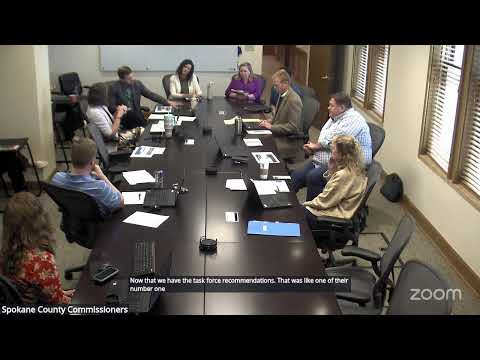
County finance staff presented a suite of revenue scenarios to Spokane County commissioners on July 6 to support the Safe & Healthy task‑force recommendations, including sales‑tax tenths for public safety, a 0.1% mental‑health sales tax, the housing/behavioral‑health 1/10th known locally as "15 90," and several property‑tax levy examples.
A county finance presenter said the county estimates roughly $17.2 million in annual revenue per 0.1% of a mental‑health sales tax in 2027 and that, under one county‑level scenario, the county’s share would be about $9.2 million after city shares are applied. Staff cautioned these are preliminary figures and that city councilmatic adoption of similar taxes reduces the county’s portion — a dynamic that complicates long‑term bonding assumptions.
On allowable uses under the 15 90 authority, staff outlined capital spending for affordable housing and behavioral‑health facilities, operations and maintenance for new units, rehabilitation, and limited bond uses. Commissioners pressed staff for statutory clarifications, for example whether freestanding involuntary evaluation‑and‑treatment (E&T) facilities qualify; staff said the statute lacks detailed definitions and they will seek further guidance.
Staff also presented a preliminary 2027 projection for a 0.1% mental‑health sales tax that showed about $17.2 million in revenue and roughly $16.8 million in projected ongoing program expenditures, including detention‑service programming, therapeutic courts, pretrial mental‑health positions, juvenile mental‑health counselors and ASO community services. Staff described the estimates as "very, very preliminary" and said more detailed program and administrative breakdowns will return as budget work continues.
On opioid settlement receipts, staff warned against programming those funds until final decisions about the PAC center are made; they reported $400,000 in projected ongoing PATH operations for 2027 but recommended pausing major programming until site and operational decisions are settled.
Commissioners and staff debated property‑tax levy options, with one example showing a $45 million levy would increase the county portion by roughly $0.45 per $1,000 of assessed value and would raise approximately $45 million in revenue; staff noted political considerations and the relative burden differences between property and sales taxes.
Next steps: staff will refine estimates, supply a detailed list of programs currently funded by the mental‑health sales tax, consult bond counsel about the revenue‑sharing risks if cities enact taxes, and expect a facilities report from consultants targeted for August 18.