Get Full Government Meeting Transcripts, Videos, & Alerts Forever!
Get email alerts on the Local Budget topic
No spam. Unsubscribe anytime.
Buncombe County adopts amended FY2027 budget reverting to prior property values after state law change
Summary
Facing two recent state laws that affect the use of 2026 reappraisal values, the Buncombe County Board of Commissioners voted unanimously at a specially called meeting to adopt an amended FY2027 budget that reverts to prior (2021) property values and sets a county tax rate of 61.54¢ per $100 of assessed value under that scenario.
At a specially called meeting, the Buncombe County Board of Commissioners voted unanimously to adopt an amended fiscal year 2027 budget that reverts to prior (2021) property values, a move staff said would require a county tax rate of 61.54¢ per $100 of assessed value to produce the revenue assumed in the adopted budget.
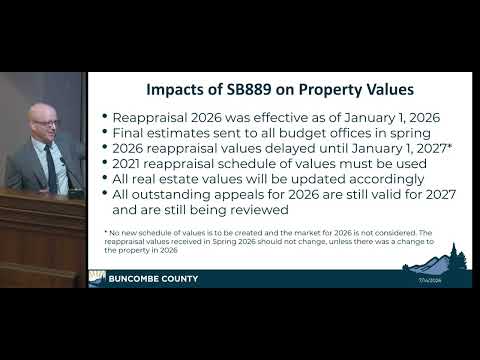
The action came after staff described two recently enacted pieces of state legislation officials said affect how and when local governments may use newly reappraised 2026 values. John Hudson, a county staff presenter, told the board that the county’s total 2026 assessed value was $77.7 billion and that prior (pre‑reappraisal) values summed to about $54.7 billion; reactivating the prior schedule to generate the same property tax revenue would require the higher rate of 61.54¢ per $100 of assessed value. Hudson said the county’s adopted FY2027 budget was $484.4 million and had assumed a tax rate of 43.20¢ per $100 based on the reappraisal.
Why it matters: County staff and commissioners said the choice before them was whether to participate in a statewide moratorium (described in staff remarks as coming from “state bill 889”) that would delay the use of 2026 reappraisal values, or to enact a narrowly framed option (described as part of “state bill 474”) that would permit use of the 2026 values only if the county set its tax rate rounded up to the nearest cent from the revenue‑neutral rate (for Buncombe, staff said that would be 40¢). Adopting the 40¢ option using the updated values, staff said, would reduce revenues by about $24.8 million and require budget cuts to reach balance.
During the presentation, Eric Kreger, the county tax assessor, explained the practical effects of the moratorium: personal property (for example mobile homes and business equipment) is reappraised annually and would not be subject to the moratorium, but real‑estate reappraisal values would be delayed; outstanding appeals (Kreger said there were about 16,000 outstanding appeals) remain valid under the law and owners could continue to appeal. Kreger also explained that equalization of public‑service properties — values appraised by the North Carolina Department of Revenue such as utilities and railroads — would be applied using the county’s assessment ratio, which staff said would replicate a revenue loss the county experienced previously when reappraisal was delayed.
Public comment and board remarks emphasized the consequences. Pepe Acebo, identifying himself as a school board member with Asheville City Schools, thanked commissioners and staff “for support of public education” and for a thoughtful budget process. Commissioners repeatedly cited the transparency of the county’s multi‑month budget work and expressed frustration with the timing and effects of the state legislature’s actions. Chair Ms. Jones said the county had completed a seven‑month budget process and described the need to revisit that work because of the state bills: “Our Republican controlled legislature…has singled out Buncombe County residents,” she said.
Several commissioners warned that choosing the option that used reappraisal values but reduced revenue would force cuts to schools, public safety and other services. Commissioner Wells argued the county needed to preserve funding for essential services and announced a new general assistance program: “We have funded a new general assistance program, termed GAP, to assist our residents who are experiencing temporary financial hardship,” Wells said, describing the program as open to qualifying homeowners and renters for essential expenses.
The board considered the staff recommendation labeled as option 1 (reactivate prior values). Commissioner Hardy moved to adopt an amended FY2027 budget with the prior values and the following tax rates under option 1: Buncombe County 61.54¢ per $100 of assessed value; unified fire district 17.38¢; Asheville City Schools supplemental district 11.75¢. Commissioner Sloan seconded the motion. Chair Ms. Jones called the vote; the motion carried unanimously (the transcript records the motion as passing unanimously; individual roll‑call votes were not listed in the meeting transcript).
After the vote, the board recessed into a closed session to consult with counsel about ongoing litigation (Buncombe County v. HCA Management Services, LLP, et al., case no. 1:24‑cv‑227, U.S. District Court, Western District of North Carolina) under statutory authority G.S. 143‑318.11(a)(3). County staff told the board no formal action was expected to follow the closed session.
What remains unresolved: Staff outlined two distinct paths available under the state laws. The county’s adoption of the prior‑values budget preserves the spending levels in the adopted FY2027 budget but, as staff noted, shifts the tax burden and raises the county rate under the prior schedule; the long‑term implications for appeals, equalization and municipal or district impacts will depend on later administrative adjustments and any further legislative fixes.
The county and staff indicated they would continue public outreach and appeals support for property owners while implementing the budget amendment.