Get Full Government Meeting Transcripts, Videos, & Alerts Forever!
Get email alerts on the Open Space And Recreation topic
No spam. Unsubscribe anytime.
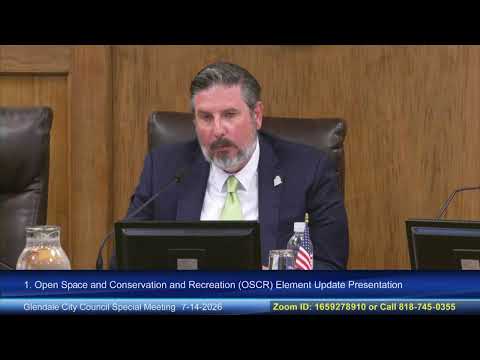
Glendale council hears update on combined Open Space, Conservation and Recreation (OSCAR) element
Summary
Consultants for Glendale presented an informational update on the combined Open Space, Conservation and Recreation (OSCAR) element on July 14, outlining inventory findings (about 6,000 acres of parks/open space, 286 acres developed), outreach methods including a statistically valid mailed survey (target N=600), and a draft timeline that runs through CEQA toward a hoped-for adoption next spring.
Glendale’s City Council on July 14 received an informational briefing on the city’s combined Open Space, Conservation and Recreation element—branded OSCAR—from consultants at All In Consulting Firm. The presentation reviewed the city’s parks and open‑space inventory, outreach methods and early findings, and outlined a schedule for community review and the parallel California Environmental Quality Act (CEQA) process.
Jessica Hansen of All In Consulting Firm told council members the OSCAR approach folds Open Space and Recreation into one element to reduce conflicting policies and allow a deeper subject‑specific update. "We have over 6,000 acres of parks and open space. Around 286 acres of that are developed parkland," Hansen said, noting some open space is held in conservation easements or lies in the Verdugo Mountains, Los Angeles National Forest and San Rafael Hills.
Hansen described outreach that included pop‑up events, mailed and online surveys, and focus groups. To ensure representative input, consultants ran a statistically valid mailed survey that targeted 600 responses; Hansen said the team hit that target. She said the mailed sample produced a different demographic profile from the self‑selected online responses and traveling boards, which skewed younger.
On survey findings, Hansen reported that "over 80%" of respondents rated parks, community centers or open space as in "excellent" or "good" condition, while also highlighting maintenance, access and equity gaps. The presentation emphasized climate and safety drivers for OSCAR policy: inequitable tree canopy distribution, concentrated urban heat in south and southwest neighborhoods, and wildfire risk along the urban‑wildland interface.
Council members pressed for clarifications. Council member Garpetian asked whether the reported housing‑burden figures (55% of owners, 59% of renters) included insurance or other housing‑related costs; Hansen replied the measure looks primarily at rent and mortgage using a 30–40%‑of‑income threshold and does not fully capture all ancillary housing costs. "So when you take into account certain different types of insurance or different utilities that might not be included, it could be even higher," she said.
Council member Asante asked whether site assessments considered accessibility for people with disabilities; Hansen said site visits included a high‑level review of accessibility (restroom access, building access, playground features for neurodivergent children) and that programming for families with children who have special needs had been flagged as a gap. Asante also asked about the composition of focus groups and outreach channels; Hansen said the parks team worked with nonprofits and stakeholders and welcomed additional participants who volunteered to be included.
Council member Artisoff urged development of a heat‑map or index to identify priority areas and asked for a general timeline. Hansen said the team is exploring a combined access‑based and population‑based standard, expects an administrative draft this fall, plans community review in October with revisions through the winter, and anticipates completing CEQA in late winter with a return for adoption in early spring next year (schedule contingent on CEQA and external delays).
Hansen repeatedly stressed that the meeting was an update and no council action was requested. Mayor Kasakhian thanked staff and commissioners for outreach and noted meeting materials and the presentation should be made available online for public review. The special meeting adjourned at 4:41 p.m.; the council then called the regular meeting portion and read closed‑session items including anticipated litigation under Government Code §54956.9 and real‑property negotiations related to 151 East Colorado Street and the Armenian American Museum and Cultural Center of California.
What happens next: consultants will post materials and maps online, continue pop‑ups through July and August, release a draft element and hold fall community meetings, and proceed with CEQA work into the winter with a target return to council for adoption in early spring 2027 (Hansen noted schedule is contingent on CEQA timing).