Get Full Government Meeting Transcripts, Videos, & Alerts Forever!
Get email alerts on the Utilities Rates topic
No spam. Unsubscribe anytime.
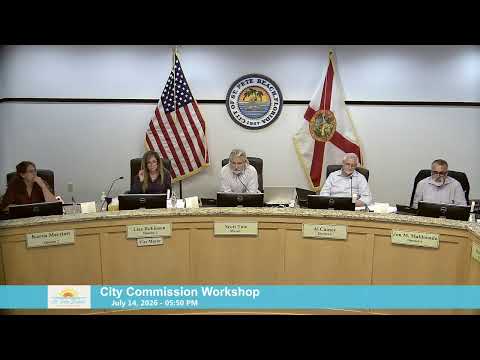
St. Pete Beach workshop: consultants recommend large, phased utility rate increases and a revamp of commercial wastewater billing
Summary
City consultants told commissioners that reclaimed water, stormwater and wastewater funds currently fall short of operating and capital needs and recommended phased rate increases and a commercial wastewater rate redesign; commissioners asked staff for business‑impact analysis and peer comparisons before acting.
Consultants presenting a multi‑system fee study to the St. Pete Beach City Commission said the city's reclaimed water, stormwater and wastewater enterprise funds are not generating enough revenue to cover operating costs, debt service and planned capital work and recommended phased, multi‑year rate increases and structural changes to commercial wastewater billing.
"We want to make sure that the enterprise funds are self sustaining," said Sean Ocasio, senior manager with the consulting team, summarizing the study's primary goal of aligning rates with costs and debt‑coverage requirements.
Why it matters: the three utility funds face rising operating costs, low customer growth and large capital programs. The consultant described a reclaimed water capital plan of about $4.5 million and a stormwater portfolio that includes projects shown in a resiliency fund totaling roughly $133 million. For wastewater, the team identified a near‑term capital program that includes major force‑main work and pump‑station projects and cited projected additional annual debt service beginning in 2029.
Key numbers and proposals from the presentation: the consultant said projected revenue at existing reclaimed water rates is about $1.1 million in 2026 and recommended a rate path that would include a 50% increase in 2027 followed by roughly 8% annual increases through 2031, moving the current base service fee (listed in the study as $25) toward about $37.50 and rising again by 2031. For stormwater the firm proposed roughly 15% annual increases for the first three years and smaller increases thereafter; the consultant cautioned that if the full $133 million resiliency program were included in base rates, impacts would be far larger. For wastewater the analysis targets roughly 16% annual revenue increases for 2027–2029 and a smaller adjustment in 2030 to reach revenue sufficiency and reserve targets.
A central recommendation was a structural change to commercial wastewater billing: scale base charges by meter size and bill all built flows for commercial accounts rather than exempting an initial flow block. The consultant said that under current billing practices multifamily customers appear to be paying about 138% of system average cost per thousand gallons while commercial customers pay about 77%, producing cross‑class subsidies that the redesign aims to reduce.
Commissioner concerns and staff direction: commissioners welcomed the study's diagnostics but repeatedly warned about the near‑term impact on small businesses. "I think that's wise to do; it's crazy that we've been charging the same rate for every meter size," said Commissioner Marriott, but he added caution: "for the smallest of small businesses ... an extra 4 or $6,000 a year can be ... very important to them." Several commissioners asked staff to return with: (1) a breakdown of how many businesses fall into each commercial meter size, (2) peer comparisons (Treasure Island, Madeira Beach, St. Petersburg and Pinellas County), and (3) a business‑impact analysis that shows typical bill changes by usage and meter size.
Connection fees: the consultant also presented a wastewater connection‑fee methodology that includes existing investment and includable planned projects divided by conveyance capacity; the model produced a per‑ERU fee that rose by roughly 45% in the consultant's scenario (from the current fee into the neighborhood of $4,649 per ERU in the model shown).
Next steps: commissioners directed staff to return with the requested comparisons and more granular impact modeling for small commercial customers and to further refine the wastewater connection‑fee recommendations. The commission did not take any votes at the workshop.
The commission paused the workshop for follow‑up and agreed to continue the discussion at a subsequent session.