Get Full Government Meeting Transcripts, Videos, & Alerts Forever!
Get email alerts on the Drug Policy topic
No spam. Unsubscribe anytime.
Seattle committee reopens debate, advances plan to prioritize in-field drug diversions to LEAD
Summary
The Seattle Public Safety Committee on July 14 reviewed Council Bill 121248, which would amend the city's drug ordinance to prefer in-field (pre-booking) 'warm handoffs' to LEAD recovery-service providers; central staff warned of capacity and budget implications and scheduled a follow-up hearing for July 28 open to amendments.
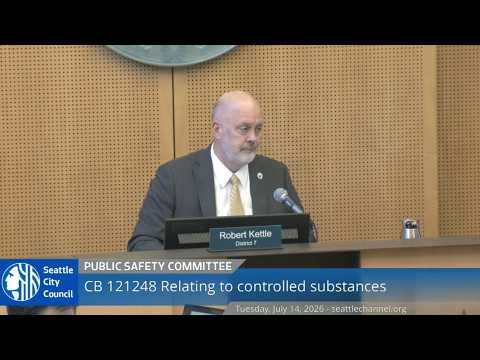
The Seattle Public Safety Committee, chaired by Robert Kettle, heard a detailed presentation on July 14 of Council Bill 121248, a proposal to amend the city's drug ordinance to prioritize in-field pre-booking diversions — commonly known as 'warm handoffs' — to LEAD recovery-service providers instead of other alternatives such as charge-by-officer referrals or arrest-and-release.
Central staffer Greg Doss told the committee the proposed ordinance updates the city's implementation of state law after the Washington Legislature reclassified public possession and use crimes in 2023. "This change would not preclude other alternatives to booking such as a charge by officer referral or an arrest and release, but it would set a preference, a city policy preference for direct handoff to recovery service providers," Doss said, summarizing the bill's intent.
Why it matters: Doss presented staff data showing that between 2024 and 2025 the Seattle Police Department increased arrests for drug use or possession by 47% while law enforcement assisted diversions through LEAD fell by about 30%, and charge-by-officer referrals rose. Those trends, Doss said, and capacity constraints for LEAD in 2025, motivated the council to codify a stronger preference for field-based diversion. The bill would also remove a behavioral health advisory committee that was created but never established by the executive and would add modest changes to data-collection requirements.
Public testimony: Dozens of commenters — many current or former LEAD participants and LEAD staff — urged continued and reliable funding for the program. "LEAD works. I am proof," said Johnny Bousquet, a LEAD participant who described his recovery and employment after intensive case management. Edward Jackson, a LEAD case manager, described the program's role connecting clients to housing, treatment and court advocacy and asked the council to "please continue to fund the LEAD program."
Council discussion: Members praised the testimony but pressed central staff for operational detail and data. Vice Chair Sacca described the draft changes as a rational modernization; Councilmember Lynn and others asked whether "field-based" handoffs would preclude handoffs at precincts and raised the need for more clarity about definitions. Doss said "recovery service provider" is intentionally not narrowly defined in the bill to avoid excluding potential providers but noted that, under current state definitions, only some local providers (Evergreen Treatment Services and REACH under PDA) meet statutory criteria for certain recovery-navigator programs.
Capacity and budget questions were central. Councilmember Rivera noted that the council allocated funds to LEAD in the budget (she referenced $20 million for LEAD-related work) and asked how that funding is translating into diversions, given the reported drop in LEAD enrollments. Doss said any increase in field-based diversions would likely create staffing and administrative costs that would need to be addressed in the city's 2027-28 budget process or via adjustments to other contracts.
Enforcement and discretion: Councilmember Juarez raised a practical scenario about officer discretion in a transition period and asked how officers will be expected to offer diversion if a person declines or if circumstances make diversion impracticable. Doss replied that SPD policies adopted after the 2023 ordinance already require officers to perform threat-of-harm assessments and give them options that include calling LEAD's 24/7 line for a warm handoff; in practice, he said, in-field transfers have higher enrollment success than charge-by-officer referrals because LEAD can meet the person where they are.
Next steps: The chair said the committee will hold another hearing on July 28, which will be open for amendments and may include presentations from PDA's LEAD administrators, Harborview and other stakeholders. Doss asked councilmembers to submit amendment ideas to central staff promptly to allow time for legal review.
What the committee did not do: No vote was taken on July 14. The meeting ended with the committee scheduling the next hearing and inviting amendments.
The hearing transcript, staff memo and the draft ordinance are available on the committee's webpage; central staff said the July 28 session will include more data and opportunity for amendments.