Get Full Government Meeting Transcripts, Videos, & Alerts Forever!
Get email alerts on the Regional Security Unowas topic
No spam. Unsubscribe anytime.
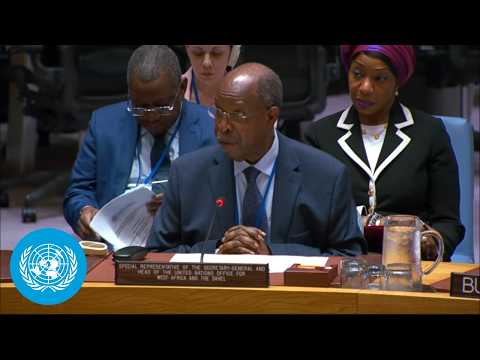
UN official warns of acute terrorist threat and mass displacement in West Africa and Sahel
Summary
An agency official for the United Nations Office for West Africa and the Sahel (UNOWAS) told the council that terrorist groups are increasingly using drones, communications tools and cryptocurrencies, and that roughly 6.8 million people are internally displaced across the region; an independent strategic review of UNOWAS was also announced.
An agency official for the United Nations Office for West Africa and the Sahel (UNOWAS) briefed the council on a sharp rise in insurgent activity, cross-border attacks and large-scale displacement across West Africa and the Sahel.
"The threat posted by terrorists and other non state armed groups remains acute, especially in the Central Sahel and Northern Nigeria," the agency official said, adding that these groups are "increasingly using advanced technology such as drones, means of communication, and cryptocurrencies." The briefing, presented to the council by Leonardo Santo Simeon, President of the council, cited coordinated attacks in Mali, attacks in Niger and persistent assaults in Burkina Faso.
The official outlined the humanitarian toll in the region, saying "about 6,800,000 people were internally displaced across the region in addition to around 1,280,000 refugees and asylum seekers, including approximately a 220,000 in Benin, Ghana, and Togo." The briefing also said migration pressures have sharply increased in Liberia, where the Burkinabe migrant population was reported to have risen "from about 40,000 to around 120,000 today," placing strain on host communities and services.
The report listed recent security incidents and impacts: a coalition of violent groups staged simultaneous attacks on April 25 in Bamako and other Malian localities, causing civilian and military casualties and partial blockades that disrupted supplies and power; attacks were reported at Niamey airport and against a military base in Tawa; Burkina Faso has seen drone-enabled operations and announced plans to recruit large numbers of reservists and forces by the end of 2026.
UNOWAS also flagged escalating drug trafficking and youth vulnerability, constrained humanitarian access limiting life-saving assistance, and attacks on schools that imperil future prospects for communities. The official said regional actors are attempting to respond through dialogue and cooperation: an Accra consultative conference in January convened leaders and partners, ECOWAS has taken steps to operationalize its standby force (albeit at a level below what is needed due to financial limits), and the African Union has increased cooperation with ECOWAS.
The briefing pointed to several positive governance developments, noting peaceful elections in Benin, Cabo Verde, Cote d'Ivoire and Guinea and reforms such as Ghana's creation of a specialized high-court division to expedite corruption and asset recovery cases and The Gambia's appointment of a special prosecutor and criminal division. The official also highlighted international legal steps, including final-phase implementation of the 2002 International Court of Justice judgment between Cameroon and Nigeria and Ghana's referral of a maritime dispute with Togo to arbitration under the United Nations Convention on the Law of the Sea.
On prevention and resilience, the official said security responses alone are insufficient and called for investment in social, economic and environmental foundations of peace. The briefing described dialogues convened on water diplomacy ahead of the 2026 United Nations Water Conference and cooperation on maritime security and drug-related youth dialogues with UNODC.
The council was told that, following a presidential letter dated 02/19/2026, the secretary-general has launched an independent strategic review of UNOWAS's mandate and activities; the briefing record names a former president of Ethiopia in charge of the review as "madame Saleh Warkeszood." The official framed the review as intended to make UNOWAS more adapted to evolving realities in the region.
Leonardo Santo Simeon thanked the briefers and opened the floor to council members for statements. No formal Council vote or decision was recorded in the briefing segment.