Get Full Government Meeting Transcripts, Videos, & Alerts Forever!
Get email alerts on the Education Budget topic
No spam. Unsubscribe anytime.
Stafford County board approves FY27 budget, reallocates one‑time funds to add four counselors
Summary
Facing a roughly $1.1 million reconciliation after a county appropriation cut, the School Board approved the FY27 budget amendment that funds four additional high‑school counselors by reallocating recurring textbook dollars and one‑time funds while trimming buses, targeted paraprofessionals and some security sandbox spending.
The Stafford County School Board unanimously approved an amended FY27 budget after a lengthy discussion about how to reconcile a roughly $1.1 million shortfall created by a Board of Supervisors appropriation change.
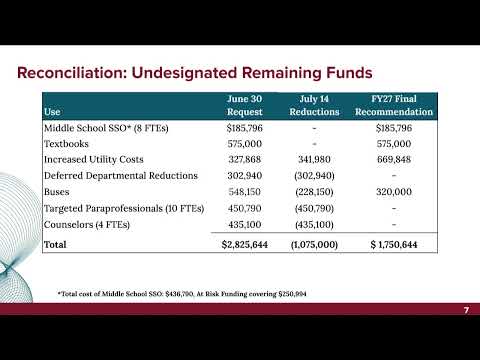
Dr. Smith, the division presenter, told the board the county's amended resolution reduced the division's allocation by about $1,075,000 and stressed the division needed to find additional reductions and reallocations to balance the FY27 operating plan. To address the shortfall, the board authorized reassigning recurring textbook funds and $392,000 of unassigned one‑time funds, and trimming a security sandboxes project by roughly $43,000, to produce $435,100 that will pay for four new counselor positions at high schools.
The vote followed sustained debate over tradeoffs. Dr. Smith framed the counselors as an urgent mental‑health intervention: "We had...4...students confirmed death by suicide this year," and the division recorded 2,956 crisis referrals, 845 suicide risk screeners that led to more than 300 full suicide risk assessments and 307 threat assessments, figures used to justify prioritizing counselor hires. Board members who supported the amendment said those data compelled immediate action to reduce counselor caseloads.
Opponents and some fiscal conservatives warned that using one‑time funds to cover recurring salary costs creates a fiscal "cliff" next year and requires the board or staff to identify recurring dollars in the FY28 budget or risk losing the positions. Dr. Smith and staff acknowledged that caution, saying using one‑time funds is not their preferred fiscal practice but that doing so would allow hires to begin before the school year and supervisors could be asked next year to restore recurring funding.
Other changes approved as part of the reconciliation included: reducing recurring bus replacements from five to two in the operating budget; eliminating funding for targeted paraprofessionals tied to interventionist staffing (the division previously proposed funding interventionists by eliminating 38 paraprofessional roles and funding 19 interventionists); preserving restricted at‑risk and special‑education funds; increasing recurring utility funding by a recommended $669,000 due to projected rate increases; and preserving funding for textbooks in part while deferring some purchases so the counselors could be brought on board immediately.
Board members also discussed short‑term options for covering textbooks and other implementation costs, including redirecting some one‑time funds that had been allocated to stage rigging repairs (staff said $392,000 had been freed) and trimming noncritical projects on the one‑time list.
The board directed staff to prepare the resolution amendment and scheduled a short break to finalize the language; the roll call vote to adopt the amended FY27 budget passed unanimously. Dr. Smith and staff said they would return with more detailed expenditure and utility‑usage data after the new schools had been operating long enough to measure actual utility consumption.
The board adjourned after the vote.