Get Full Government Meeting Transcripts, Videos, & Alerts Forever!
Get email alerts on the Urban Forestry topic
No spam. Unsubscribe anytime.
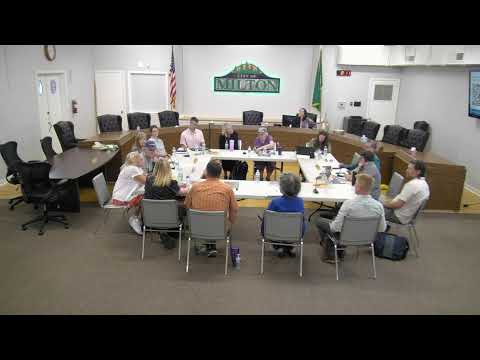
Milton council and planning commission debate proposed tree-protection ordinance, ask staff for targeted edits
Summary
A joint session of Milton’s council and planning commission heard a DNR presentation on urban forestry and debated a proposed ordinance that would limit removal of exceptional and significant trees on private and vacant lots. Councilors raised concerns about homeowner burdens, ADUs and enforcement; no vote was taken.
A proposed urban forestry ordinance designed to protect Milton’s large and significant trees was the focus of a lengthy joint meeting of the Milton City Council and Planning Commission, which heard technical advice from the Washington State Department of Natural Resources and debated permit costs, exemptions and enforcement measures.
Planner Anjali Stonlecker opened the discussion by tying the draft ordinance to the city’s comprehensive plan (the “2044” vision adopted in 2024) and saying the proposal is intended to “maintain and strategically expand the city's urban tree canopy” and to implement minimum standards the comp plan calls for. She described a permit structure for removing exceptional or significant trees, a replacement-tree credit system and a suggested minor-permit fee of $75 to cover staff time.
Ben Thompson, of the DNR’s Urban and Community Forestry Program, told the meeting his office provides technical, educational and grant support and framed trees as municipal infrastructure that deliver environmental, economic and social benefits. “When you plant the tree, it's helping to provide not only the environmental benefit of shade, cooling the air, providing wildlife habitat, but it's doing all of this other, like, work for communities,” Thompson said. He also noted tool limitations but said Milton’s canopy is currently estimated between roughly 20% and 30% and that the city would need “about 7,000 more trees” to reach a 50% canopy benchmark used by one analyzer.
Supporters on the planning commission and on council urged quick adoption to slow canopy loss. Planning commissioner Jacqueline Whalen said the community must “make Milton not only a better place for people, but a better place for trees,” and Council member Susan Johnson said, “We can't wait anymore on passing this,” citing recent developments that removed large trees.
Other council members warned the draft could place disproportionate burdens on homeowners. Several speakers raised concerns that homeowners with limited incomes could be unable to afford arborist reports, site plans or replacement trees and that incentives, waivers or a tree-fund could be needed to avoid inequitable impacts. One councilor asked how the draft would handle accessory dwelling units (ADUs) and properties where owners remove trees before redevelopment; staff said the ordinance seeks to reduce that loophole but acknowledged some legal and tracking limits when ownership changes prior to development.
On enforcement, staff and commissioners proposed a mix of education, contractor outreach, permit requirements and a tree fund funded by development mitigation. The draft also includes high penalties intended as a deterrent; participants asked for clearer language on fines and how penalty revenue would be used. Thompson described grant programs and technical assistance from DNR, noting DNR received roughly $3 million in state funding in 2021 and that grant availability has varied year to year.
No formal vote or ordinance adoption occurred at the meeting. Council and commission members asked for more specific language changes and for public outreach before advancing the draft. Planner Stonlecker asked council members to email targeted concerns and suggested edits (a one‑week timeframe was discussed) so staff and the planning commission can refine the ordinance and return it for further consideration.
The meeting closed without a vote; council members and commissioners indicated they will continue refining the ordinance and pursue additional public engagement and targeted edits before any final action.