Get Full Government Meeting Transcripts, Videos, & Alerts Forever!
Get email alerts on the Wastewater topic
No spam. Unsubscribe anytime.
Bennington approves SRF loan applications for wastewater filter upgrade, sets path to November bond vote
Summary
The Select Board voted July 13 to approve step 1 and step 2 State Revolving Fund loan applications and named Town Manager Daniel Monks as authorized representative to pursue funding for a proposed $4.5–$4.95 million upgrade to the wastewater plant to meet new state phosphorus limits.
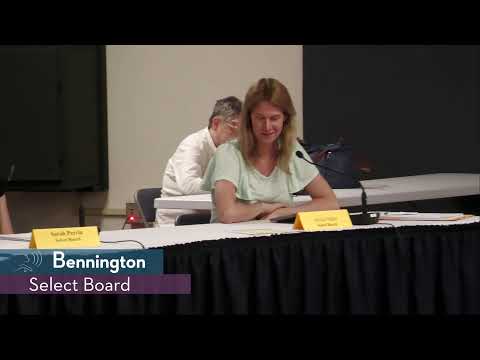
The Bennington Select Board voted July 13 to authorize two State Revolving Fund (SRF) loan applications and to designate Town Manager Daniel Monks as the town's authorized representative as it moves toward a bond vote this November to fund an upgrade at the wastewater treatment facility.
Consultants said the plant is now subject to a new Vermont discharge permit that imposes a phosphorus cap the town must meet by Dec. 31, 2028. "The limit is 3,260 lbs annual load, and a 0.21 milligrams per liter monthly average," Larry Gates told the board during a slide presentation explaining treatment processes and compliance options.
Gates and the engineer described the existing sand filter building as beyond its useful life and recommended repurposing that footprint to house stainless-steel disc filters paired with a modest chemical addition system. Presenters gave a planning-level estimated total project cost in the presentation near $4.95 million (slides also listed a $4.495 million figure); they said a bond vote will be required for construction and pledged a revised cost estimate ahead of any bond ballot.
The consultants outlined three financing scenarios. Option A would front-load the cost with a one-time rate increase (presenters showed an example 12.4% one-time increase, roughly a $52 annual rise for a typical sewer user under the board's assumptions). Option B would phase increases over several years and use reserves; Option C would consume reserve funds to avoid immediate rate impacts but delay replenishment of reserves. Consultants recommended pursuing SRF funding because the program can bundle planning, design and construction loans and may include subsidies; an engineering subsidy of about 50% and potential construction subsidies (illustrative figures cited in presentation) could reduce net costs but were not guaranteed.
Town Manager Dan Monks told the board the SRF process allows for favorable repayment terms and a delayed repayment start in some cases: "If we apply for the State Revolving Loan Fund, we could, it could possibly open up some grant opportunities," he said, and urged consensus to move toward a November bond vote so the town can keep schedule to meet the state deadline.
After board questions about life expectancy (consultants cited a typical 20-year life for the overall installation and 10-year replacement cycles for some filter components), sludge handling and whether the estimate included all engineering and construction, Select Board member Jim Sullivan moved to approve the step 1 and step 2 SRF applications and to designate the town manager as the authorized representative; Jackie Matz seconded. The motion passed and the board directed staff to continue work toward a November bond vote, with financing scenarios and rate-impact projections to be provided to the board in advance of any ballot language.
What happens next: staff will finalize SRF applications, pursue potential subsidies, update cost estimates, and return to the board with a financing plan and proposed bond language in advance of the November vote.