Get Full Government Meeting Transcripts, Videos, & Alerts Forever!
Get email alerts on the Traffic Calming topic
No spam. Unsubscribe anytime.
NDOT advances revised traffic‑calming plan for Mary Dale Drive; neighborhood to decide by postcard vote
Summary
NDOT project staff presented updated designs for Mary Dale Drive in Nashville that include three speed cushions and a "slow safer shoulder." Staff reported an 85th‑percentile speed of about 40 mph and said a neighborhood ballot (one vote per eligible property; 66% yes required) will determine whether the project proceeds.
At a second community meeting, NDOT project staff presented revised traffic‑calming designs for Mary Dale Drive in Nashville and outlined a neighborhood ballot that will determine whether the project moves to construction.
NDOT staff said field data show the 85th‑percentile speed on Mary Dale at about 40 miles per hour and two‑way volume under 1,000 vehicles per day. "That we collected the 85th percentile speed at 40 miles per hour," the NDOT project staff said, citing the speed data as a principal reason for proposing physical calming measures.
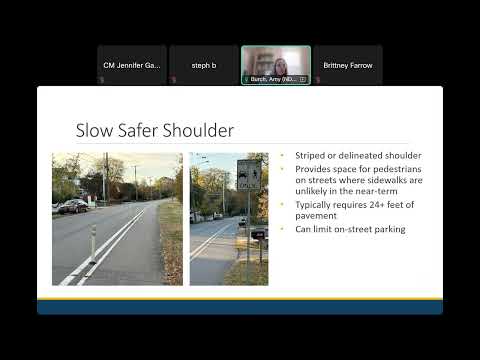
The updated design includes three sets of rubberized speed cushions, laid out with wheel gaps to allow emergency vehicles to straddle them, and a "slow safer shoulder" using existing pavement that will be delineated with flexible posts. NDOT staff described cushions as easy to install and remove and said prior studies on similar streets reduced average speeds from about 31 to 22 mph and 85th‑percentile speeds from 37 to 25 mph.
On dimensions and placement, staff said cushions will be centered within an approximately 18‑foot travelway, each cushion about 6 feet wide with a typical 10‑foot length and two feet between cushions. Staff read measured placement examples: the first cushion set is about 38 feet south of the driveway at 4007 Bridal Drive, the middle set about 34 feet north of the driveway at 4020 Meridale Drive, and the next set about 64 feet south of the driveway at 4028 Meridale Drive.
Residents asked about moving one of the cushions closer to the downhill approach to Old Hickory Boulevard to slow drivers sooner. NDOT staff said they would double‑check spacing near the driveways and could adjust the location: "I think that would be fine. I think we should have enough space between these two driveways. I'll double check that," the NDOT project staff said.
The slow safer shoulder is designed as roughly a one‑foot shoulder plus a one‑foot buffer using excess pavement; staff said that will typically narrow the travel way to about 18 feet and be separated from travel lanes with flexible delineator posts. One resident said a painted line alone would not feel safe for children; "I want my kids to be able to, like, ride their bike down the sidewalk, and I don't know that a line is gonna stop anybody," the resident said, arguing for physical delineation. Another participant cautioned that some neighborhoods have had complaints about pylons or delineators elsewhere.
NDOT described the vote mechanics and schedule: the project team will mail a postcard with a unique ID and QR link to an online ballot; voting will be open six weeks, and each eligible property—residential properties, churches and schools within the affected area—receives one vote (vacant parcels and businesses are not eligible). "And if 66% of the respondents vote yes, then the project will move forward and get added to our construction queue," the NDOT project staff said. Staff estimated about 17 eligible properties on the affected portion of Bridal Drive will receive ballots.
If the neighborhood approves the project, NDOT said it would place the work in the construction queue and expects installations within roughly eight to 10 months, though staff noted recent projects have sometimes moved faster. Staff also said the project page on Engage Nashville (engage.nashville.gov/trafficcalming) will host the plans, ballot results (pass/fail, not individual votes) and contact information; the postcard will include a phone number to reach a project manager for ballot assistance.
NDOT staff said they would incorporate the requested small adjustment to the cushion location and then mail ballots, likely just before the July 4 holiday, with voting open for six weeks. The meeting ended after staff confirmed they would post the meeting materials online and provide updates on the Engage Nashville project page.